


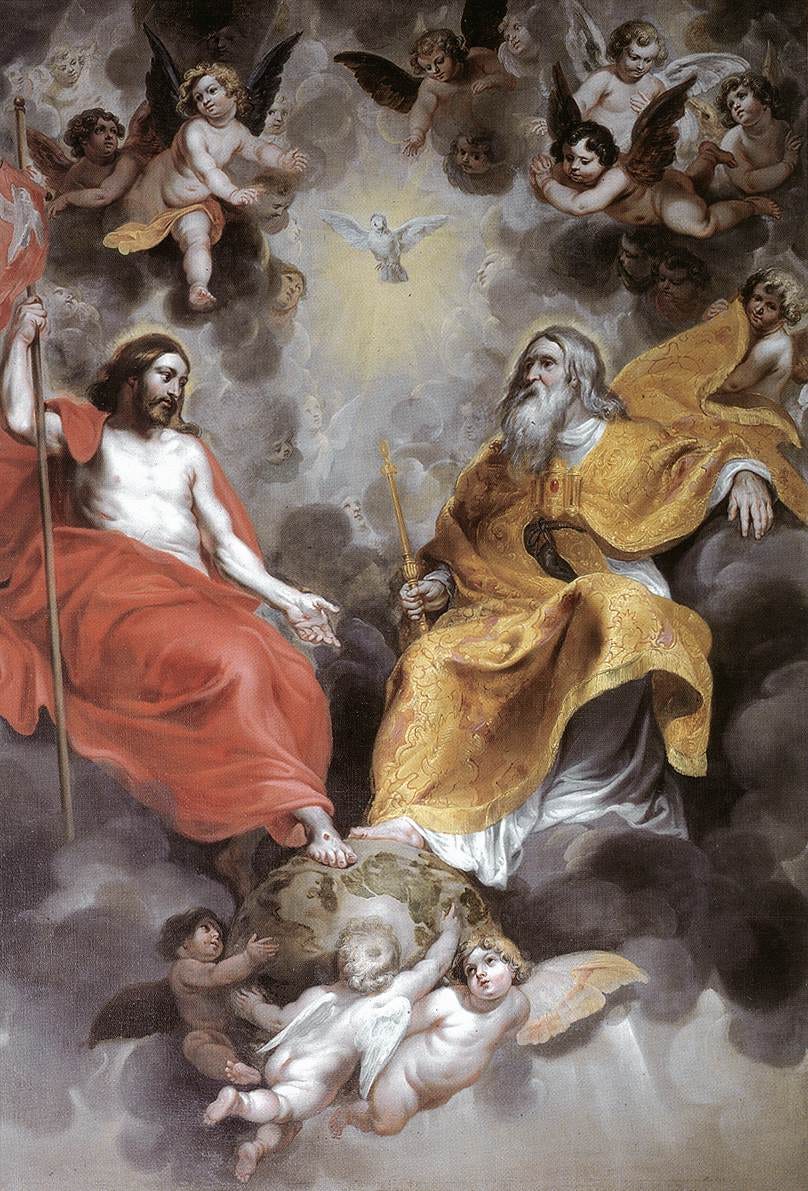
From Holy Communion to the Blessed Trinity
Fr Marie Vincent Bernadot, OP, The Newman Press, 1955
Explained by Deacon Tracy Jamison, OCDS, in relation to The Interior Castle of St Teresa of Avila
One of the main reasons why we fail to grow in holiness even though we may be daily or frequent Communicants is our lack of a correct understanding of the objective nature of Holy Communion. We need better instruction and deeper meditation. Greater comprehension of truth inspires greater devotion and self-sacrifice. The divine Life in our souls imparts divine Light to our intellects and divine Love to our wills, but these graces are not apparent to us at first. Our abiding personal union with God is from the Sacraments of the Church by grace. Baptism begins the union. Confirmation strengthens the union. Confession and Anointing of the Sick restore and refresh the union. Holy Communion gradually perfects the union in our souls. Holy Orders and Holy Matrimony sustain the union in the community. Ordinarily, we ascend to a conscious ineffable union with God by means of frequent Confession and Communion. Christ is the Vine. We are the branches.
We receive gifts at Holy Communion according to the degree to which we have disposed ourselves to them by the practice of asceticism and the spiritual and corporal works of mercy. The path to subjective mystical union is through the practice of self-denial and penance. Our spiritual poverty, chastity, and obedience must be absolute but also gradual and adjusted to our temperaments and state of life. We must spiritually give up everything we have, like the poor widow in the Temple in Jerusalem who gave her last two coins to God.
Holy Communion gives us the whole Christ, and through union with the Humanity of Christ we receive the Holy Trinity to dwell in our souls by grace. The soul then informs the heart. Holy Communion is a greater participation in the Life of the Trinity than sanctifying grace alone is. It is objectively a participation in the inner Life of the Trinity. In Holy Communion we receive this divine Life and are enabled to participate in it actively, knowing and loving God with the divine Knowledge and Love that we have received through Christ.
Holy Baptism, Holy Confirmation, Holy Confession, Holy Penance, and Holy Communion potentially give us a conscious supernatural state that already approximates the Beatific Vision. Carmelites call this state the Transforming Union or Spiritual Marriage (7th Mansions). It is an apophatic and ineffable form of mystical knowledge which comes through our participation in divine love after Spiritual Betrothal (6th Mansions), the outpouring of the Holy Spirit (as at Pentecost), and the sacrifice of oneself totally for the Mission of the Church. This state may or may not be accompanied by miracles. Confession prepares us for Communion by rendering us able to receive and actualize the gifts that Christ is giving us in Communion. Ordinarily, Christ limits himself to giving gifts according to the degree to which we have prepared ourselves for them. Going to Confession once per week is more perfect and more efficacious than going to Confession only once per month or less. We should add to the penances that we are assigned in order to satisfy the temporal punishment that is due our sins.
Eucharistic union is higher than the abiding union of sanctifying grace. Grace is an infused accident that flows into our souls from the Eucharistic union because of the substantial presence of Christ’s Body and Blood in it. Our souls are naturally consubstantial with our bodies. In Holy Communion, Christ enters both. Holy Communion is itself the highest possible union with the Holy Trinity. Engaging in it changes us both objectively and subjectively. After Communion, the grace of it remains in us, and thus we can remain united with Christ objectively in our souls above the level of our human consciousness. We receive and live the very Life of Christ to one degree or another. All the graces that we receive are given through and caused by the Sacred Humanity of Christ. Holy Communion is the closest possible union with the Humanity of Christ, and thus it gives us the most graces. It unites our bodies and souls to the Body and Soul of Christ so that the Body and Soul of Christ can act upon our bodies and souls directly and more perfectly. By grace, Christ acts upon our intellects and wills immediately, regardless of whether we are conscious of his action. God alone has the divine power to act through our acts without violating the freedom of our wills.
The Sacred Humanity of Christ, including his Sacred Mind and Sacred Heart, is present in the consecrated Host and Cup substantially through his Body and Blood. He becomes present in our souls mystically by sanctifying grace through his Humanity. We become mystically one because Christ is substantially one. Grace is the supernatural life of our souls. Our souls were created with the capacity to receive this higher kind of life. Holy Communion is the best means of establishing and augmenting this life in our souls. This life begins in us with Baptism and the grace of justification, either sacramentally or by desire or martyrdom.
Holy Communion increases God’s influence over our intellects and wills by increasing grace in our souls. Thus we grow in supernatural knowledge and love, knowing and loving with God’s own Knowledge and Love, which are given to us objectively in our souls and increase through the Sacraments. Through the transforming union of Spiritual Marriage, we eventually become subjectively conscious of this participation in the Life of the Blessed Trinity, if we are willing to sacrifice our own minds and hearts to it and to the Mission of the Church.
Our objective union with God is by sanctifying grace and does not require mental recollection or conscious awareness. Only mortal sin can destroy our objective union with God. But active and passive recollection perfect it by grace. Only God can complete the good work that he has begun in us. The union is given to us and is made subject to our will, which can either destroy it or cultivate it. God objectively unites our souls to himself but leaves it up to us how close to come to him subjectively. His influence upon our intellects and wills thus depends upon our active cooperation with it. We will gradually receive perfect contemplative union to the degree to which we dispose ourselves to receive it.
We must dispose and prepare ourselves for the reception of holy contemplation just as we must for the reception of Holy Communion. The practice of God’s presence in active recollection and mental prayer is the habit by which the self is brought into conformity with the action of God in the soul. It is also the means by which we dispose ourselves for the mystical nuptial union that is over and above the ordinary state of grace but is organically one with it as its perfection. If we respond properly and habitually to that which we have received, we are given more.
We must therefore endeavor to practice active recollection in the presence of God in our souls and in the tabernacles of our churches at all times. All our thoughts and desires must be directed to God. We must be constantly and mentally turned toward the Blessed Sacrament, as devout Jews were always mentally turned toward the presence of God in the Temple in Jerusalem. The unconscious personal union with the Blessed Trinity that we possess by Baptism, Confirmation, Penance, and Communion must become a conscious mental union. The practice of meditation and contemplation is the means by which to make the union more actual and perfect. God unites our souls to himself and expects us to strive to unite ourselves mentally and affectively to his presence in our souls. With his help, we can do it. Sacramental grace makes it possible for everyone.
The graced soul through Holy Communion attains and enjoys an abiding existential union with God. The self must strive to turn completely away from sin and vice and to participate fully in this abiding mystical union. Those who habitually engage in the battle of mental prayer and sacrifice themselves for others as Christ did will attain perfection, in which the self becomes totally united with the soul in the life of grace. The active practice of recollection is a necessary condition for perfect nuptial union and integration. Lack of recollection always leads to sin and spiritual immaturity or death. God requires the engagement of the whole person. Perfect union cannot be attained by those who culpably reject or neglect the Holy Sacraments, which make it generally available to all.
Mental prayer can become constant by grace and be habitually practiced at all times and in every circumstance. The three stages that we must pass through on the Way of the Cross are bodily suffering, grief of heart, and desolation of soul. For a description of this development, read the Book of Job or the Book of Tobit, or simply meditate on the Gospels. Wisdom is understanding the Cross of Christ, and holiness is embracing it. After a mystical encounter with the Cross of Christ always comes a greater participation in his Resurrection, along with a greater joy and happiness through contemplative union with God. Thus are we transformed to have a greater capacity for God. We are divinized through the Holy Cross, whether we recognize it or not.
The purpose of Eucharistic union is to unite us with Christ Crucified and to enable us to embrace the Cross as the means by which to become other Christs subjectively, as Mary and Joseph did. We lose ourselves in Christ, but we do not lose our souls or our faculties. We lose our own minds and hearts and gain the Sacred Mind and Heart of Christ by perfect participation in his divine Knowledge and Love through his Sacred Humanity. God offers this grace to all generous souls who by grace make him the absolute priority and motivation of their lives. We gain the Mind and Heart of Christ perfectly when we have completely lost our own minds and hearts. When our subjective selves are totally congruent with the objective presence of God in our souls, then we have perfect joy and finally discover who we were always meant to be.
About Deacon Tracy Jamison, OCDS, PhD
Deacon Tracy Jamison was raised in a Christian family as the son of a Scotch-Irish evangelical minister in the Campbellite tradition. As an undergraduate he majored in Biblical and Ancient Near Eastern Studies at Cincinnati Christian University, where his parents had been educated. At this institution he met Joyce, who was completing a degree in Church Music, and after graduation they entered the covenant of Christian marriage in 1988. Through the study of philosophy and the writings of the Early Church Fathers, Tracy was received into the full communion of the Catholic Church in 1992. Under the influence of the theological writings of St. John Paul II he began to study the works of St. Teresa of Avila and St. John of the Cross and entered formation as a Secular Carmelite of the Teresian Reform. In 1999 he completed the doctoral program in Philosophy at the University of Cincinnati, and in 2002 he made his definitive profession as a Secular Carmelite. In 2010 he was ordained as a permanent deacon of the Archdiocese of Cincinnati. Currently he is an associate professor of philosophy at Mount St. Mary’s Seminary of the West.
© 2026, Lawain McNeil, Mission Surrender, LLC.
So much to digest about the Lord's Supper, but so good to be reminded of. Thanks, Lawain, for sharing..