


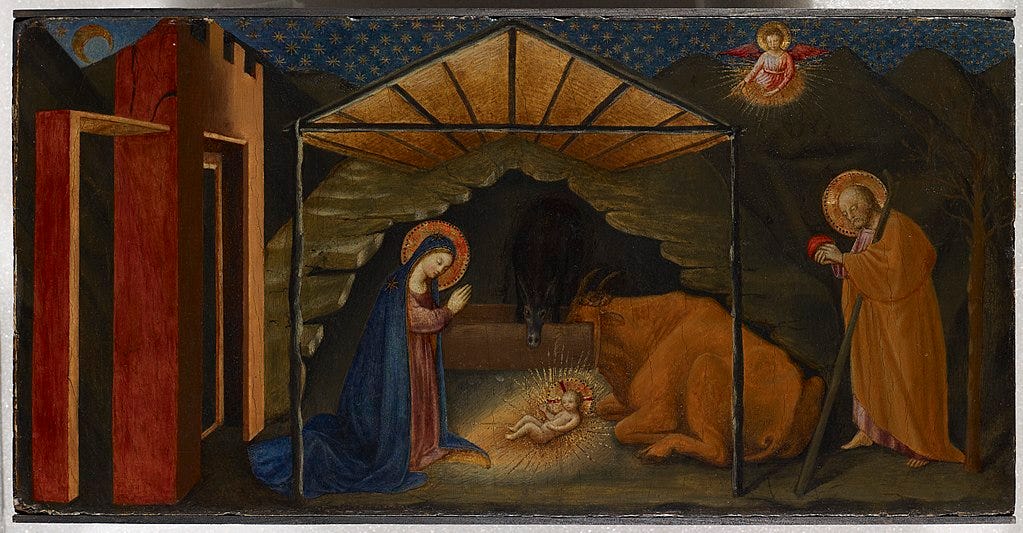
To the readers of The Call to Holiness, Merry Christmas. God bless you all. May the Christ Child enter our hearts, that we may share His peace with the world. - Lawain McNeil
The Nativity of the Lord
Today Christians celebrate what they proclaim to be the most significant event that ever happened in our world: the Incarnation of God as man. And yet in the modern world it is very difficult for many people to see the Incarnation as a real historical event or even to believe in a God for whom such a miracle would be possible. In the changes that we have experienced in our own nation during our own lifetime, something disturbing has captured the minds and hearts of many people and filled them with doubt and confusion. What is it? Think back to your own childhood, and how you first learned the true meaning of Christmas. What has happened in our nation and in our lifetime since then? What paradigm shifts have occurred? What patterns and tendencies can we observe?
In my own life, I was raised in a Protestant Christian family and educated in public schools. I clearly remember being introduced at a young age to the traditional Latin hymn Adeste Fidelis in a Christmas pageant in a public elementary school. We were public-school children, but we were required to memorize the Latin verses of O Come All Ye Faithful, which I found rather challenging. We sang it in Latin at the beginning of the play while processing in from the back of the gym through the assembly of our parents and then up onto the stage, carrying candles. The whole play was about the birth of Christ, our Savior, and it contained various prayers to God, openly offered in the gym of a public school. Was that a protest? Certainly it was a public form of resistance to the general trend of the culture at the time.
In the early 60s, the US Supreme Court had banned public prayer and Bible-reading in public schools. At the time, the 1965 animated television special A Charlie Brown Christmas seemed like another little protest against those rulings. As written by Charles Schulz, the Christmas play in that television special is portrayed as taking place in a public school, which was in fact the long-standing custom in most places, and it concludes with a recitation of the Gospel by the character Linus, using the traditional text from Luke, Chapter 2. Charles Schulz probably did not intend it as a protest or a political statement, but when he was asked why he chose to focus on the true meaning of Christmas, he simply responded, “If we don’t do it, who will?”
What exactly precipitated the US Supreme Court’s banning of public prayer in our public schools? Historians tell us that for 186 years both school prayer and Bible-reading had been promoted in our nation to encourage the development of good character and good citizenship. But then in 1951 the New York State Board of Regents routinely approved a nondenominational prayer to be voluntarily recited at the beginning of each school day. It read: “Almighty God, we acknowledge our dependence upon Thee, and we beg Thy blessings upon us, our parents, our teachers and our country.” The intention behind the prayer was simply to honor God as the Creator and benevolent Source of all unity, truth, and goodness. There was no intent to force any particular religion on anyone. Students who did not want to recite the prayer were allowed to remain silent. The intent was to honor God insofar as he can be known to everyone by reason and classical metaphysics, apart from divine revelation and religion.
The intention behind the prayer was simply to honor God as the Creator and benevolent Source of all unity, truth, and goodness.
After a decade of public-school children reciting this prayer daily in New York public schools without controversy, a few parents claimed that it violated the First Amendment’s Establishment Clause by establishing a state-imposed religion. This claim was rejected by the New York Supreme Court and two appeals courts, but in the famous 1962 case Engel v Vitale the US Supreme Court ruled that the three lower courts had been wrong. Thus the long-standing practice of public prayer and Bible-reading in our nation’s schools was abruptly brought to an end by the complaints of a few parents who did not want children to hear teachers and peers invoking God publicly. The fundamental mistake was to suppose that invoking God as the Creator is inherently an appeal to divine revelation, not an act of human reason acknowledging the ultimate Cause of its intelligence and goodness.
This decision was the first of a series of terrible mistakes made by the Supreme Court, and we still suffer from the consequences. It effectively eliminated the public recognition of God in our public schools and in the public square. On that day, by one Supreme Court decision, we became a secular nation, instead of one nation under God. And yet all children have a natural moral right to learn about God insofar as he can be known by reason alone, just as they have a natural moral right to learn about arithmetic, physics, and chemistry. All governments and nations have a natural moral duty to acknowledge God and give thanks to him publicly, insofar as his existence and goodness can be known by reason alone. The Founding Fathers of our nation, even those who were not Christians, understood that all people have a natural civic duty to give God the public civic worship that is owed to him in justice, though now most of us have forgotten it. The Founding Fathers were certainly not Christian nationalists, but they accepted and promoted the traditional principles of natural moral law.
The dissenting Justices in the Engel v Vitale case argued that the First Amendment’s Establishment Clause was designed not to prohibit government involvement with religion, but to prohibit the establishment of a state-sponsored church. The majority decision, the dissent declared, denied schoolchildren “the opportunity of sharing in the spiritual heritage of our nation,” noting numerous instances of God in the public square, including the motto “In God We Trust” on our currency, the invocation “God Save this Honorable Court” at sessions of the Supreme Court, and prayers offered in Congress. But the decision had been made, and the ethos of our nation was thus changed. The spiritual world of the schools of our nation was shattered. The world in which our nation attempted to preserve its spiritual heritage disappeared. Is it not long past time for us to ask whether that change was really for the better? Has the condition of our culture and our public schools improved or deteriorated since the early 60s? It always takes time for cultural changes wrought by the Supreme Court to trickle down to actual policies, but trickle down they must. As historians point out, the beliefs of public-school administrators recorded in national polls clearly indicate the detrimental effects of the Engel v Vitale ruling. In 1966 public-school administrators named the development of “moral and spiritual values” as their second most important task, but by 1992 that task ranked dead last among educational priorities.
The invasion that is destroying our nation can be identified and given a name. It is an ideology that is often called “Secularism.” It is found both on the political Right and on the political Left. It is intrinsically opposed to everything that Christians believe about Christmas, and to most of what theists in general believe about God. It creates unwarranted doubts in people’s minds and erodes their faith, even the faith of someone like Charles Schulz. It sterilizes the public square and neuters the traditional family. It reinterprets every religious doctrine by means of its own inner-cosmic metaphysics. It invades our entertainment media and attempts to eliminate everything transcendent. Whatever cannot be reduced to the space-time continuum is considered unreal and insignificant. It interprets the cosmos as a closed system of natural causes in perpetual change and then denies that there is a Creator. It thrives on inner-cosmic fantasies and virtual realities, and it misappropriates sciences for its own atheistic ends. It pronounces against the existence of an infinite God in favor of mathematical pluralism and posits instead the existence of an infinite multiverse. It is open to magic and sorcery but closed to sacraments and saints. It rejects the existence of angels and demons, but it fantasizes about super-evolved aliens and fantastic super-heroes from other galaxies and parallel universes. It opposes what is natural and promotes what is unnatural. It dazzles the mind and entices the heart to the point where reality becomes boring, and normality becomes abnormal.
But we who know the truth about Christ are grateful for the real peace and joy that he brings into our lives. When we look at the Christ Child lying in the manger, we do not see just another super-hero among a whole host of super-heroes. We do not see some kind of friendly alien from another planet or parallel universe who comes to save the world through a superior technology. No, we see our divine Creator, who has entered his creation and now lives among us. We see the God of Gods and the Prince of Peace. We see the Uncaused Cause and the Source of all truth, science, power, and goodness. We see the divine Person who has assumed our human nature and feeds us with his very Body, Blood, Soul, and Divinity. Because we still have faith in our minds and hearts, we can see the reality of it, even though it is not apparent to our senses. The secularized mind by contrast is totally lost in the cosmos and has no ultimate explanation of its own intelligence and goodness. Believe it or not, the true cause of violence in our world is relativism, which like a bad virus corrupts everything it touches, including science and religion. True faith in God is never the source of violence. Apart from faith in God, peace has never been sustainable. Only a God can save us now, and Christ is that one true God. Even when there is no room for him in the public square, he still abides with us in the mangers of our hearts and offers us the peace and joy of his Presence. All he asks is that we keep the covenant he has given us and then share the peace and joy of the true meaning of Christmas with others. “If we don’t do it, who will?”
This homily on the true meaning of Christmas was adapted by Deacon Jamison from an essay by Cheri Pierson Yecke, a retired Professor of History and Political Science who served as the Commissioner of Education for the state of Minnesota and who asks that we remind everyone of the time in our nation when prayer, Christmas pageants, and Bible readings were allowed in public schools (https://intellectualtakeout.org/2020/12/charlie-browns-christmas-message-to-america/).
About Deacon Tracy
Deacon Tracy Jamison was raised in a Christian family as the son of a Scotch-Irish evangelical minister in the Campbellite tradition. As an undergraduate he majored in Biblical and Ancient Near Eastern Studies at Cincinnati Christian University, where his parents had been educated. At this institution he met Joyce, who was completing a degree in Church Music, and after graduation they entered the covenant of Christian marriage in 1988. Through the study of philosophy and the writings of the Early Church Fathers, Tracy was received into the full communion of the Catholic Church in 1992. Under the influence of the theological writings of St. John Paul II he began to study the works of St. Teresa of Avila and St. John of the Cross and entered formation as a Secular Carmelite of the Teresian Reform. In 1999 he completed the doctoral program in Philosophy at the University of Cincinnati, and in 2002 he made his definitive profession as a Secular Carmelite. In 2010 he was ordained as a permanent deacon of the Archdiocese of Cincinnati. Currently he is an associate professor of philosophy at Mount St. Mary’s Seminary of the West.
© 2025, Lawain McNeil, Mission Surrender, LLC
Oh, the memories you kindled with this devo! Johnny & I recited and sang numerous scriptures & great old time carols…forming my faith in our Lord & Savior..