


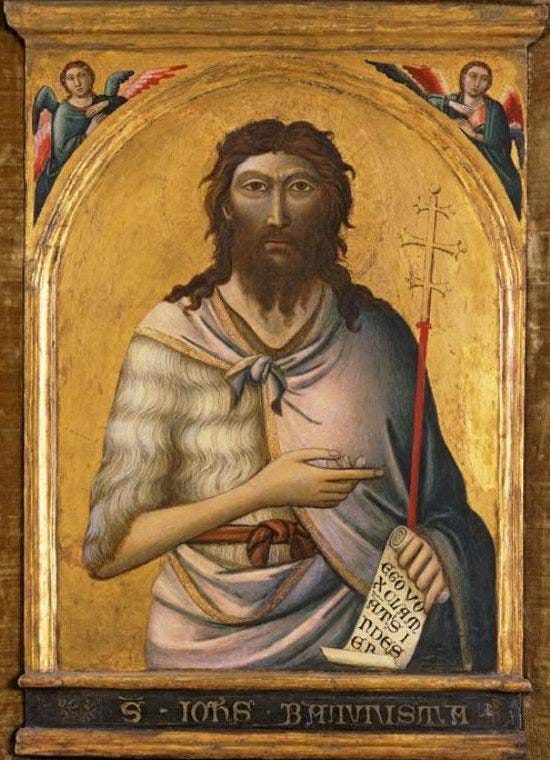
During Advent, the Church points to John the Baptist as a model of the prophetic vocation to call all people to repentance and moral reform. We all know the traditional Advent hymn:
On Jordan’s bank the Baptist’s cry
Announces that the Lord is nigh;
Awake and hearken, for He brings
Glad tidings of the King of kings.
Then cleansed be ev’ry heart from sin;
Make straight the way of God within;
Oh, let us all our hearts prepare
For Christ to come and enter there.
Jesus chose John the Baptist to be the last prophet of the Old Covenant. A prophet is someone who has the word of God and proclaims it. Such a vocation inevitably entails some kind of martyrdom. Why was John put in prison and beheaded? He told Herod Antipas and Herodias that they were in an unlawful marriage. John was exercising his prophetic vocation and informed the king and the queen that they needed to turn away from sin. And so the king’s unlawfully wedded wife asked for John’s head on a platter. He died bearing witness to the moral truth about marriage. Are we willing to die for that cause? Are we at least willing to be marginalized for that cause? John is a prophet and more than a prophet. Jesus is a prophet and more than a prophet. The Church is a prophet and more than a prophet. Through the sacraments of Baptism and Confirmation we too are called to be prophets. We have received the gift of the Holy Spirit for that purpose. We have an office, and this office has a mission to bear witness to divine and moral truth. Are we carrying it out?
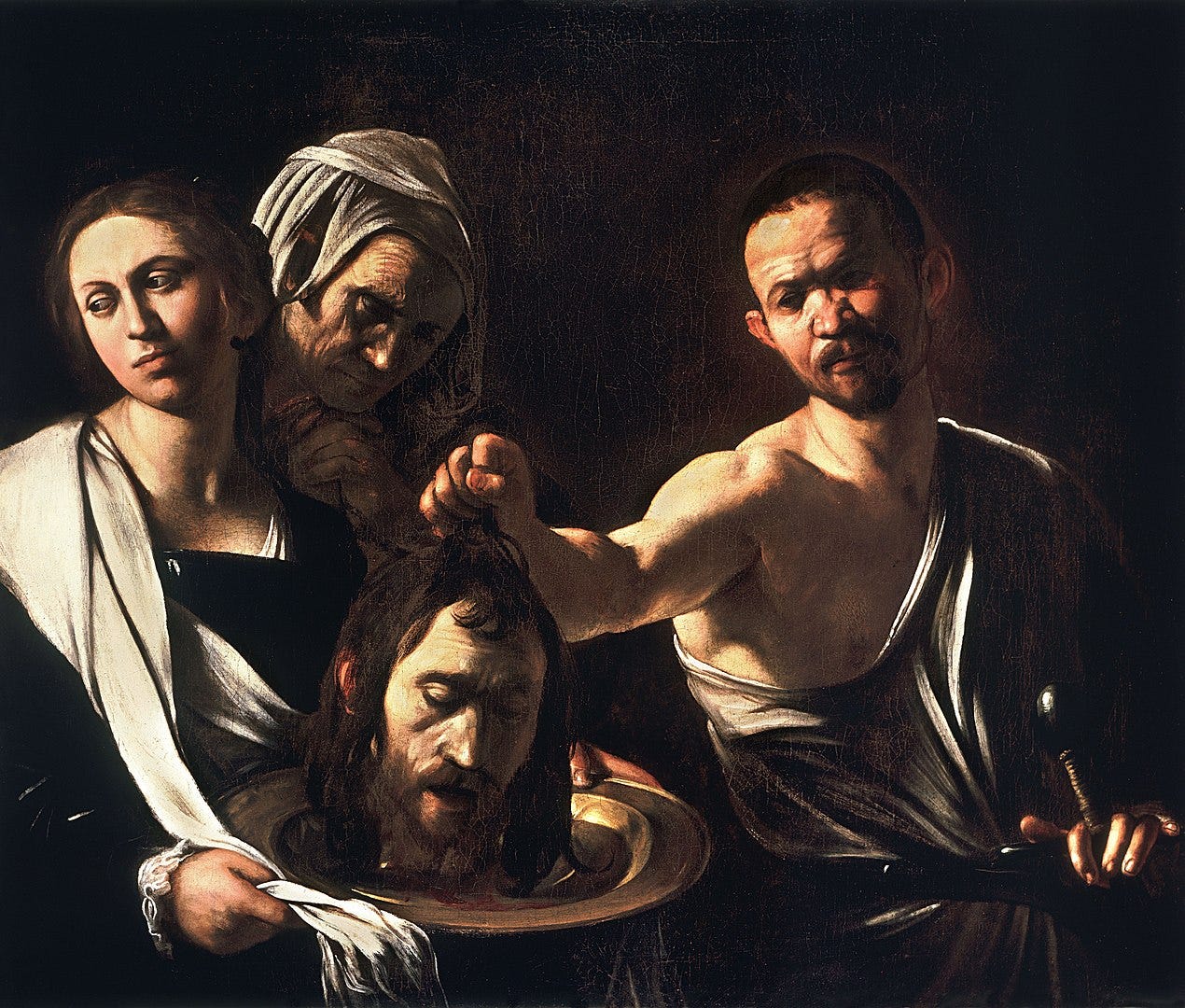
The Gospels tell us that John the Baptist was the forerunner of his cousin, Jesus the Christ. The Baptist was born just six months before the Christ. John was the last prophet before the Messiah, and he prepared the way of the Lord. The Christian revolution begins with John the Baptist. He came to bring hope to God’s people, enslaved by the Romans. His birth was surrounded in mystery. John himself became a messenger for the Lord, with a message of hope. The hand of the Lord was with him. From his mother’s womb he was called to be a prophet. His elderly parents died when he was young. But he knew that he had to prepare for the mission that he had been given. So he went out into the desert and lived the life of a Nazirite hermit.
In the Jewish tradition, Nazirites were like religious of a primitive observance. They were men and women who received a special divine call. They were consecrated and dedicated to God by a special vow. Sometimes it was a temporary vow, and sometimes it was a lifelong vow. In the Hebrew Scriptures, Samson and Samuel, for example, are Nazirites. The vow included an obligation to abstain from wine and all fermented drink. They also kept themselves ritually clean at all times, according to the Jewish laws of purity. They also refrained from ever cutting their hair. They just let it grow out. Thus we have all the icons and statues of John of the Baptist with rather long hair. That was part of the Nazirite vow.
To our eyes John the Baptist might look like a Hippie or a Rastafarian, but to Jewish eyes he would look like the prophet Elijah. Like Elijah, the Nazirites lived a life of strict self-denial and gave themselves totally to serving God. Like the Carmelites, they were filled with the spirit and power of Elijah bearing witness to God on Mount Carmel. Jesus asserted that his cousin John was Elijah, but John denied it. Is that a contradiction? No, for Jesus meant it in the typological, mystical sense, and John meant it in the literal, historical sense. Both senses are true, as they always are in Scripture.
John the Baptist was literally a Nazirite cousin of Jesus, and he literally grew up out in the desert, living an ascetical life of prayer and contemplation as a religious hermit, in imitation of the prophet Elijah. He wore a religious habit made out of camel’s hair. He kept it in place with a leather belt. He lived off the land and ate mostly locusts and wild honey. When God called him to begin to preach, he went down to one of the main fords on the Jordan River, near Bethany, where many travelers would pass by. To us he might look like a self-appointed street-preacher, but the difference is that he has the prophetic signs and credibility of a true prophet.
What did he proclaim? “Repent and be baptized, for the kingdom of heaven is at hand.” He called people to moral purity and to covenant faithfulness. He called tax-collectors to practice justice and to put an end to extortion. He called soldiers to stop all unnecessary violence and to be content with their pay. He defended traditional marriage and marital fidelity. He called everyone to the active practice of charity. “If you have two coats,” he said, “give one of them to someone who has none.” “If you have extra food, more than you really need, give it to those who are starving.”
It is not difficult to understand and appreciate the perennial value of the doctrine of John of the Baptist. But it is difficult to have the will and the courage to live it out in our own times. Are we preparing the way of the Lord? Are we detached from the goods of this world? Are we attending to the corporal, spiritual, and moral needs of our marginalized neighbors and our political leaders? Are we bearing witness to the moral truth about the sanctity of traditional marriage and human life? Are we willing to accept the difficult consequences of such a witness? Are we rejoicing in the Lord always, or are our hearts full of negativity and resistance?
As we prepare now to enter into the peace and joy of Christmas, let us pray for the spirit and power of Elijah to descend on us and to enlighten our world once again, for apart from the light of Christ there is only darkness, confusion, and violence. We must not allow the despair of the modern world pull us down. Yes, this life is difficult, and it may get worse, but in the end, faith, hope, and charity will win.
Right here and right now, there is only one thing necessary:
Then cleansed be ev’ry heart from sin;
Make straight the way of God within;
Oh, let us all our hearts prepare
For Christ to come and enter there.
Today’s Mass Collect
Almighty and merciful God, may no earthly undertaking hinder those who set out in haste to meet your Son, but may our learning of heaven wisdom grain us admittance to his company. Through our Lord Jesus Christ, your Son, who lives and reigns with you in the unity of the Holy Spirit, God, for ever and ever.
About Deacon Tracy
Deacon Tracy Jamison was raised in a Christian family as the son of a Scotch-Irish evangelical minister in the Campbellite tradition. As an undergraduate he majored in Biblical and Ancient Near Eastern Studies at Cincinnati Christian University, where his parents had been educated. At this institution he met Joyce, who was completing a degree in Church Music, and after graduation they entered the covenant of Christian marriage in 1988. Through the study of philosophy and the writings of the Early Church Fathers, Tracy was received into the full communion of the Catholic Church in 1992. Under the influence of the theological writings of St. John Paul II he began to study the works of St. Teresa of Avila and St. John of the Cross and entered formation as a Secular Carmelite of the Teresian Reform. In 1999 he completed the doctoral program in Philosophy at the University of Cincinnati, and in 2002 he made his definitive profession as a Secular Carmelite. In 2010 he was ordained as a permanent deacon of the Archdiocese of Cincinnati. Currently he is an associate professor of philosophy at Mount St. Mary’s Seminary of the West.
© 2025, Lawain McNeil, Mission Surrender, LLC