


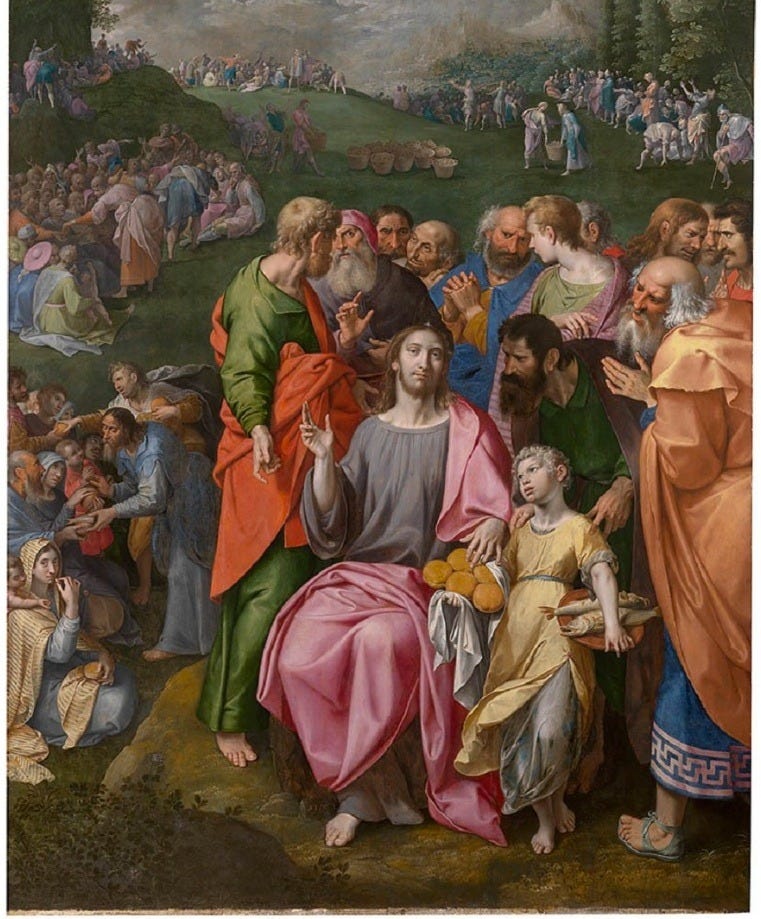
When Jesus “saw the vast crowd, his heart was moved with pity for them, and he cured their sick” (Matthew 14:14). What is pity, and does it move our hearts, as it moved the heart of Jesus?
At the beginning of The Lord of the Rings (Book One, Chapter II – “The Shadow of the Past”), we learn that when Gandalf explained to Frodo that the Black Riders were coming for the Ring that he had inherited from his uncle Bilbo, because its location had been revealed to Sauron by Gollum, Frodo exclaimed, “What a pity that Bilbo did not stab that vile creature, when he had a chance!”
And Gandalf responded from a theological perspective: “Pity? It was pity that stayed his hand. Pity, and mercy: not to strike without need. And he has been well rewarded, Frodo. Be sure that he took so little hurt from the evil, and escaped in the end, because he began his ownership of the Ring so. With pity.”
“I am sorry,” said Frodo. “But I am frightened; and I do not feel any pity for Gollum.”
“You have not seen him,” Gandalf broke in.
“No, and I don’t want to,” said Frodo. “I can’t understand you. Do you mean to say that you, and the Elves, have let him live on after all those horrible deeds? Now at any rate he is as bad as an Orc, and just an enemy. He deserves death.”
“’Deserves it! I daresay he does. Many that live deserve death. And some that die deserve life. Can you give it to them? Then do not be too eager to deal out death in judgement. For even the very wise cannot see all ends. I have not much hope that Gollum can be cured before he dies, but there is a chance of it. And he is bound up with the fate of the Ring. My heart tells me that he has some part to play yet, for good or ill, before the end; and when that comes, the pity of Bilbo may rule the fate of many – yours not least.”
As the story unfolds, and Frodo sees Gollum and begins to understand him, he does feel pity for him, and he treats him with mercy (Book Four, Chapter I – “The Taming of Sméagol”). He recognizes that he and Gollum are suffering from the same burden, the same affliction. He also teaches Sam to be merciful toward Gollum. For a while, Gollum trusts Frodo and repents, and he is almost cured, but sadly in the end he is conquered by his lust for the power of the Ring.
In a laborious act of daily self-sacrifice Frodo puts up with Gollum and carries the Ring to its final destruction, expecting to pay for this victory with the price of his own life. But in the end, the lust for the power of the Ring conquers even Frodo. Standing at the edge of the fires in Mount Doom he finds that he cannot dispose of it. He cannot resist the desire to keep it for himself (Book Six, Chapter III – “Mount Doom”).
The salvation of Frodo and Middle-earth comes about only through the mercy of God at the last minute when Gollum violently takes the Ring from Frodo and falls into the fires, perishing with it forever and ending the evil reign of Sauron. The moral of the story is clear. If Bilbo, Frodo, and Sam had not shown mercy to Gollum, but instead in justice had killed him, the Quest to destroy the Ring would have failed, and the outcome would have been far worse than death.
Like the Gospel stories of Jesus multiplying the loaves and the fishes and feeding the multitudes, the story of Frodo and Gollum teaches us the Christian Beatitude “Blessed are the merciful, for they shall obtain mercy.” It is in fact the one true story of all the saints of every time and place. It is the path of holiness and salvation. The practice of mercy is what rules the fate of us all, your fate, my fate, and the fate of our nation. When we learn that lesson, we will begin to have pity on those in need and put up with the inconvenience of assisting them.
In the face of human needs, the heart of Jesus was moved with pity. The hearts of his disciples were not, at least not at first. “This is a deserted place, and it is already late,” they said. “Dismiss the crowds so that they can go to the villages and buy food for themselves.”
Jesus said to them, “There is no need for them to go away; give them some food yourselves.” Do you know how difficult it is to feed 15,000 people, even when the food is provided? It takes a great deal of labor and patience. Did they deserve it? No. Did they get greedy and want more? Yes. When they began to follow Jesus around, he told them, “Amen, amen, I say to you, you are looking for me not because you saw signs but because you ate the loaves and were filled. Do not work for food that perishes but for the food that endures for eternal life” (John 6:26-27). Christ puts up with our imperfections and helps us grow in virtue.
The practice of mercy gives people what they need, not always what they want. In the face of addiction, the most merciful thing that we can do is to deny people what they want and to help them to discover the joy of sobriety. We must not enable destructive behaviors and base desires. But for those who want to work, we must provide employment. For those who need to escape poverty and violence and find a place to raise a family, we must provide housing and a path toward citizenship. And toward our enemies, we must “not be too eager to deal out death in judgement.” We must not strike unless strictly necessary in morally certain conditions of imminent self-defense.
In order to live like children of our gracious and merciful God and to receive the benefits of the everlasting covenant, we must purify our hearts through the practice of mercy and self-sacrifice. In the end, mercy is received by those who are merciful. In the end, true happiness is obtained by those who live a life of small, hidden acts of mercy and self-sacrifice for others, even for our enemies. That is the way of Frodo, and that is the way of Christ. Christ blesses our feeble efforts, sanctifies them, and multiplies them.
The multiplication of the loaves and the fishes by Christ points to the Holy Eucharist, the multiplication of the substantial presences of Christ under the appearances of bread and wine. “As each consecrated host is really and truly Christ, because transubstantiation multiplies not the one Christ but rather the real substantial presences of the one Christ, so each Mass is really and truly the sacrificial act of Christ, because transubstantiation multiplies not the one sacrificial act of Christ but rather the real operative presences of his one sacrificial act” (Cardinal Journet, The Mass: The Presence of the Sacrifice of the Cross, St Augustine’s Press, 2008, page 71).
In regard to Eucharistic celebration, Benedict XVI taught us that “Faith, worship and ethos are interwoven as a single reality which takes shape in our encounter with God’s agape. Here the usual contraposition between worship and ethics simply falls apart. ‘Worship’ itself, Eucharistic communion, includes the reality both of being loved and of loving others in turn. A Eucharist which does not pass over into the concrete practice of love is intrinsically fragmented” (Benedict XVI, Deus Caritas Est, 14).
Christ’s love for us is unconditional, and nothing can separate us from the love of Christ. But it is also true that there are conditions on receiving the mercy of God in Christ. To those who do not practice mercy, no mercy shall be given. The measure that we measure with will be measured back to us. Our Lord instructed us to pray “Forgive us our trespasses as we forgive those who trespass against us.” On the Cross he prayed “Father, forgive them, for they know not what they do.” We must imitate the love of Christ, who suffers for others without enabling immoral conduct. True compassion is always willing to sacrifice comfort for virtue. Sacrifice for others is the purification of love. God’s requirements are reasonable and easy to satisfy. They give us true hope that we can obtain mercy through the imitation of Christ, who really and truly sacrificed himself for us.
About Deacon Tracy Jamison, OCDS, PhD
Deacon Tracy Jamison was raised in a Christian family as the son of a Scotch-Irish evangelical minister in the Campbellite tradition. As an undergraduate he majored in Biblical and Ancient Near Eastern Studies at Cincinnati Christian University, where his parents had been educated. At this institution he met Joyce, who was completing a degree in Church Music, and after graduation they entered the covenant of Christian marriage in 1988. Through the study of philosophy and the writings of the Early Church Fathers, Tracy was received into the full communion of the Catholic Church in 1992. Under the influence of the theological writings of St. John Paul II he began to study the works of St. Teresa of Avila and St. John of the Cross and entered formation as a Secular Carmelite of the Teresian Reform. In 1999 he completed the doctoral program in Philosophy at the University of Cincinnati, and in 2002 he made his definitive profession as a Secular Carmelite. In 2010 he was ordained as a permanent deacon of the Archdiocese of Cincinnati. Currently he is an associate professor of philosophy at Mount St. Mary’s Seminary of the West.
© 2026, Lawain McNeil, Mission Surrender, LLC.