


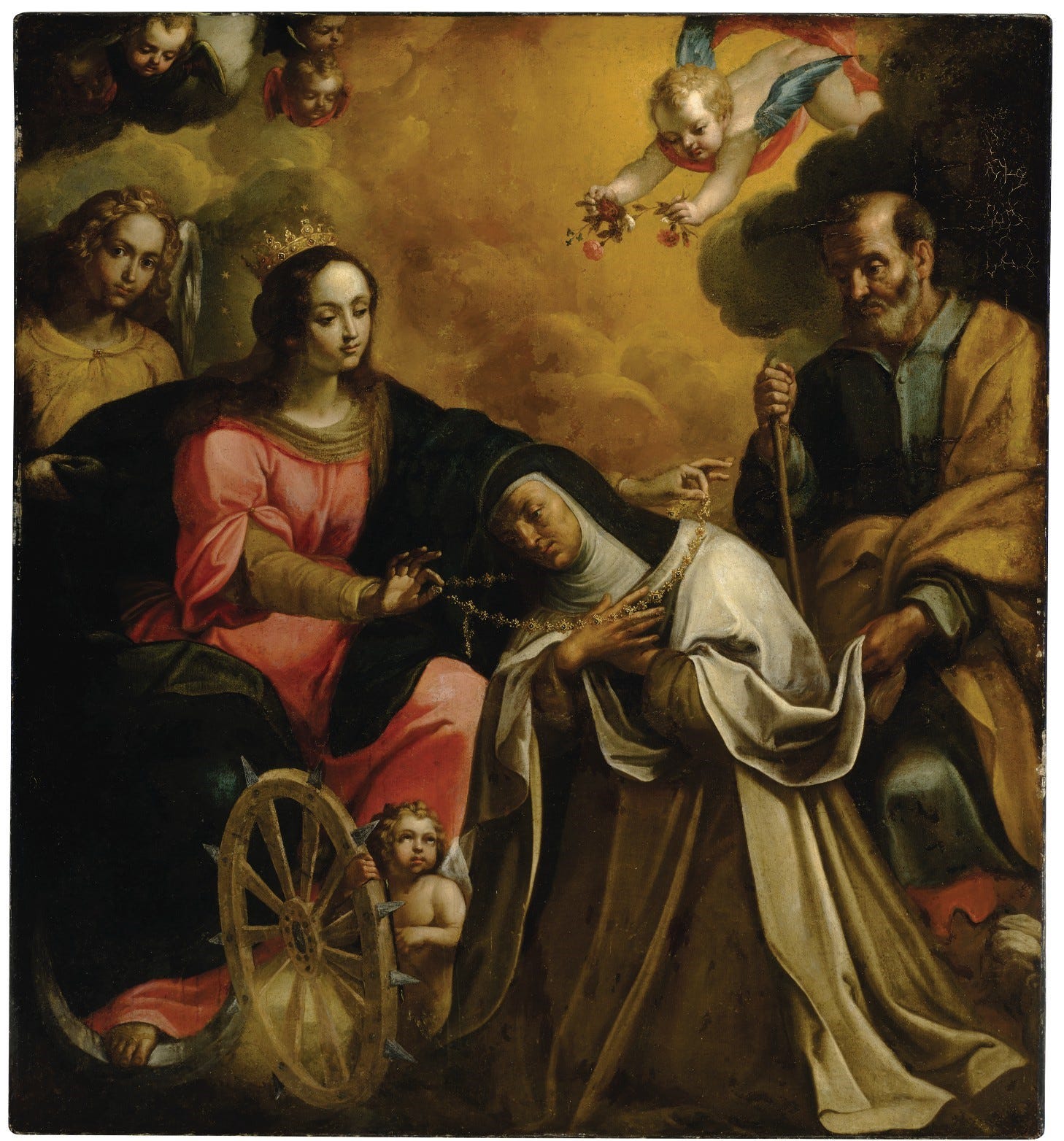
As a seven-year-old child in Avila in 1522, Teresa Sánchez de Cepeda y Ahumada convinced her older brother Rodrigo to take her down the road toward the land of the Moors (Spanish Muslims of North African descent), with the genuine desire and sincere hope that they would both have their heads cut off. Overtaken by an uncle and returned to her parents, Teresa said, “I went because I want to see God, and to see him we must die.” Rodrigo simply said that little Teresa had made him do it. She had been reading the lives of the Christian Saints and Martyrs. “Forever! O Rodrigo, think of it, the martyrs gaze upon God forever. We must become martyrs.”
Do we find Teresa’s childhood desire for martyrdom quaint, or shocking? Her life-long spiritual quest was to die to herself in order to see God. We can recognize that this ought to be the life-long spiritual quest of every Christian. Seeing God is not just a matter of understanding his nature, as is possible for us in this life through belief in the word of God, basic catechesis, and dogmatic theology. Seeing God in this life is essentially a matter of being gradually transformed by him and united with him in a personal communion of love. Using a Biblical analogy, Teresa eventually calls this existential union of the soul with God “Spiritual Marriage.”
Like the Desert Fathers before her, when martyrdom was denied her, Teresa pursued solitude and silence in order to see God in this life through personal growth in faith, hope, love, self-denial, and contemplative prayer.
The desire for martyrdom (i.e. the desire to see God through physical or spiritual death) was the specific desire that brought young Teresa to Carmel. Unable to obtain the consent of her father, on All Souls Day in 1535 at the age of 20, Teresa convinced her younger brother Antonio to take her to the Carmelite monastery of the Incarnation, after which he immediately went and entered the Dominican monastery of St Thomas. Their father came and removed Antonio from the Dominicans but left Teresa in the Carmelite monastery. Young men were expected to the serve the Spanish empire in the military. Rodrigo took a military post in the Spanish colonies of the Americas and died in conflicts with the native Americans in Chile. Antonio also went to the Americas, and he died in the Battle of Iñaquito in Ecuador. Teresa remained with the Carmelites, taking the name Teresa of Jesus, and spent the rest of her life reforming the Order of Carmel in Spain. She died on the memorial of St Francis (October 4), 1582. She was canonized in 1622, and her memorial was designated as October 15, because the ten days after her death were dropped due to the Gregorian calendar reform.*1
While Teresa was a novice in Carmel, God revealed himself to her in fleeting graces of contemplative union, the beginnings of the mystical life, which God offers to everyone who believes in him and loves him. Like St Augustine and many other saints, Teresa learned that by grace she could see God in this life in her own soul indirectly through the habitual practice of recollection, solitude, silence, self-denial, and contemplative prayer. She composed several spiritual works on prayer, out of obedience to her spiritual directors. She was able to teach others what she had learned from God about the mystical life.
St Teresa’s spirituality has three essential elements: (1) the foundational truth upon which Teresa’s doctrine rests is that God is present in the human soul; (2) the fundamental movement urged by Teresa’s doctrine is to draw close to God present in the soul and thus to be transformed; and (3) the specific goal of Teresa’s doctrine is to become perfectly united with God present in the soul.*2
The desire for the happiness of seeing God was St Teresa’s fundamental life-long aspiration. Teresa’s doctrine and example call us to put God first in our lives and to give ourselves to him unconditionally in order to enter into a personal communion of knowledge and love with him which will enable us to become more like him in this life and to have a greater happiness with him forever in the next.
*1 “Love for Love: The Life and Work of St Teresa of Jesus,” from The Hidden Life: Hagiographic Essays, Meditations, Spiritual Texts, by Edith Stein (St Teresa Benedicta of the Cross, OCD), translated by Waltraut Stein (ICS Publications, 1992).
*2 A Practical Synthesis of Carmelite Spirituality - Volume One: I Want to See God, by Bl Marie-Eugene of the Child Jesus, OCD, translated by Sr M Verda Clare, CSC, Part One: Perspectives, Chapter II: “I Want to See God” (FIDES Publishers, 1953).
© 2026, Lawain McNeil, Mission Surrender, LLC.