


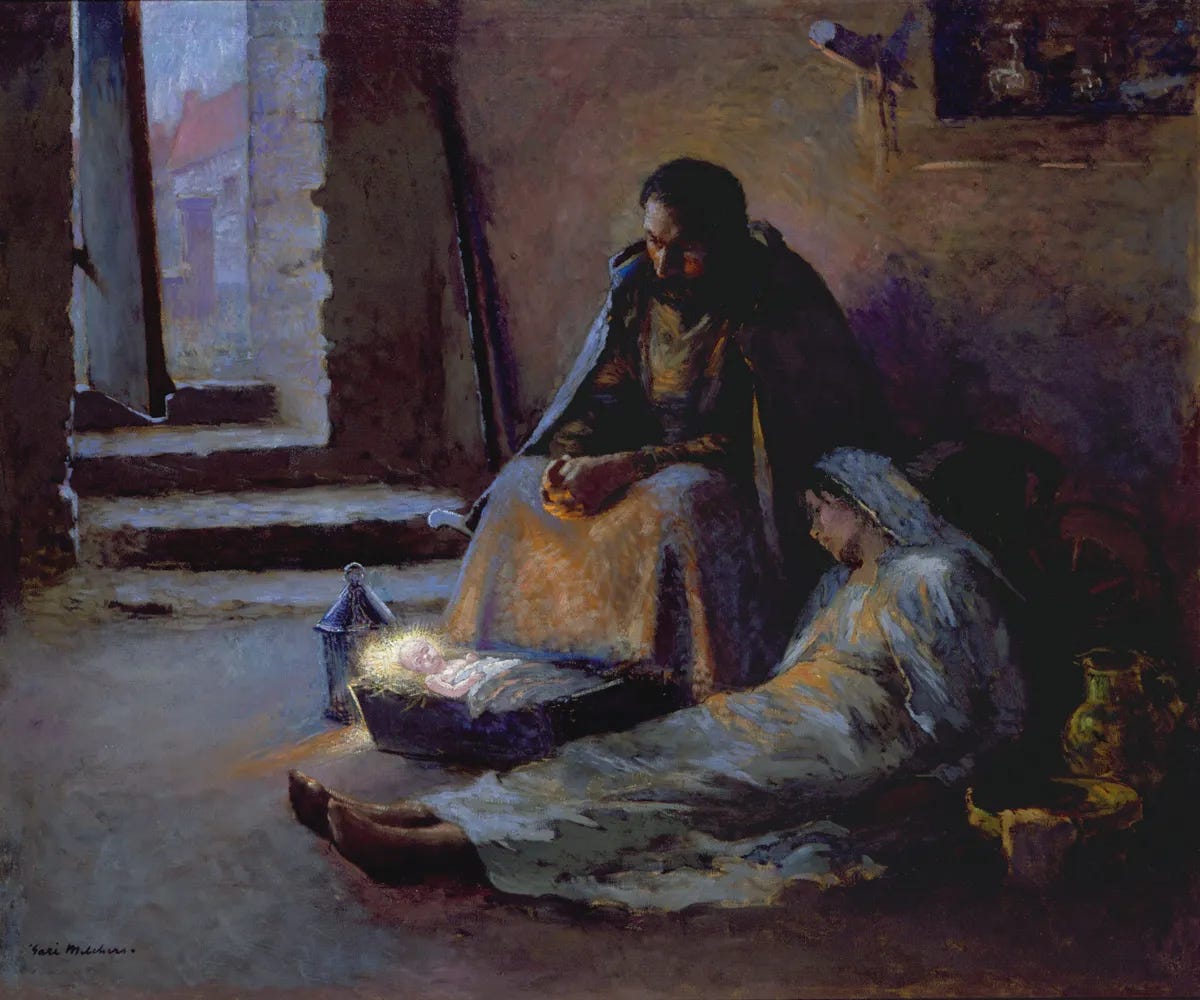
We begin with a consideration of the theological insights of Blessed Marie-Eugene of the Child Jesus, OCD, regarding the Blessed Virgin Mary, offered to us in A Practical Synthesis of Carmelite Spirituality - Volume Two: I Am a Daughter of the Church, Part Five: Holiness in Service of the Church, Chapter V: Helps and Models in the Dark Night of the Spirit. God has closely united Jesus and Mary for the realization of his designs of mercy. They have a common mission, and in its fulfillment they cannot be separated.
In this mission, Mary, like Christ, has (a) the primacy of dignity. She is the collaborator that God the Father gave to Christ, the new Eve for the new Adam. The divine paternity acts through the human nature of Christ and the human maternity of the Blessed Virgin Mary in the mystery of redemption.
In this divine mission, she also like Christ has (b) the primacy of efficacy. She is Mother wherever Jesus is Savior, and she has the spiritual power which corresponds to the dignity of this role. She is not merely a channel of grace, but a person who freely cooperates in the transmission of grace by her own will. Grace is both divine and Marian. We are truly children of God our Father and Mary our Mother, who together make us the brothers and sisters of Jesus.
In this divine mission, Mary also like Christ has (c) the primacy of finality. In the end, the blessed will reign forever with Jesus in heaven. In that kingdom, Jesus is the Messiah King, and Mary is the Queen Mother, and Joseph is the Foster-Father of the King. Next to Christ, Queen Mary exercises a spiritual Maternity of Grace and reigns over all creation, visible and invisible. These fundamental truths about Mary make it evident that the soul who is in the dark night of the spirit, as described by St John of the Cross in The Ascent of Mount Carmel and The Dark Night of the Soul, must have recourse to her as the Mother of Grace and Queen of All Souls.
Mater Populi Fidelis, approved by Leo XIV on October 7, 2025, reminded us that we must distinguish three different kinds of mediation in the distribution of grace. (1) There is essentially only one Mediator and Redeemer, who is a divine Person, Jesus Christ. This mediation is unique and incommunicable. God alone bestows grace essentially and objectively. Only an incarnate divine Person is able to make his own human nature holy. (2) Christ grants a contingent, sacerdotal, and paternal mediation to his ministerial priests by participation. (3) Christ also grants a contingent, subjective, and maternal mediation to his Church by intercessory cooperation, in which the Blessed Virgin Mary has the primacy. Mary does not objectively cause her own holiness. Just as nothing is self-caused, nothing is self-redeemed, self-justified, or self-sanctified. Whoever is redeemed is redeemed by another. Just as God alone is essentially good, God alone bestows grace essentially. Therefore, in response to the question whether Mary is a mediator of grace, we must first deny that she is essentially a mediator of grace, then affirm that she is contingently a mediator of grace, and finally clarify that she is a mediator of grace only analogically by participation in Christ’s sole Mediation which alone bestows grace essentially. The same is true of the paternal mediation of a sacerdotal minister. Mary is our Mother in the order of grace, and she grants us her maternal intercessory assistance at various moments in our lives, especially in the dark night of the spirit, but we must not suppose that her role in the mediation of grace is essentially that of a divine person or even that of a priest. Such has always been the doctrine of the Church regarding Mary. There is nothing new or different in Mater Populi Fidelis.
The providential role of Mary in the dark night of the spirit is apparent in salvation history. The faithful have always understood that mercy comes through Mary, and thus in hours of darkness they have always had recourse to Mary in supernatural hope. For example, the wearing of the scapular of Mount Carmel and the Marian promise attached to it confirm the truth that sincere confidence in Mary, asserted by a practice or prayer, assures to the sinner the grace of final perseverance.
Confidence in Mary is an exercise of the theological virtue of hope. God has made Mary the spiritual Mother of us all and has entrusted to her the exercise of his mercy. The intervention of Mary always bursts forth when things are at their worst, and the dark night of the spirit is the time in which the soul undergoes the most intense suffering that it has ever known. When it seems that God in his justice has abandoned the soul, mercy will often then be granted to the soul who seeks the help of Mary.
The soul at this point resembles the sinner separated from God, but unlike the sinner this soul suffers because it is filled with the love of God and yet finds itself separated from God. The anguish which the soul suffers in the night of the spirit is inevitable and necessary for its perfection. Hence Mary must not dispel the darkness nor do away with the sufferings characteristic of this stage of spiritual progress. Thus Mary spreads sweetness without suppressing the sufferings, and creates a soft shadow without dissipating the darkness. She does not typically seek extraordinary favors for her children, although she will whenever she judges it necessary to do so. The sweetness and the shadow are produced by the certitude the soul has of her action and by the obscure awareness of her active presence.
To know that its Mother is there, watching over it in the night, fortifies the hope of the soul in the midst of its sufferings. This certain but obscure mystical knowledge establishes a real intimacy between the soul and its Mother. Filled with divine love and continuing in agony toward the complete death of self, the soul cries not only “Father” but also “Mother.” The dark night that intensifies its longing does not prevent it from knowing the object of its longing by faith and by love. The love that illumines faith with the light of connaturality guides the soul securely in its search and leads it to the restful intimacy of an embrace which the obscurity, darkness, and anguish make more ardent and more profound. The soul finds its Mother in Mary and rests in her arms through infused supernatural knowledge and love.
In the mystery of redemption, it is through the maternity of Mary that one can obtain the Loving Wisdom of God. In the way of perfection, recourse to the intercession of Mary can be either implicit or explicit. For those who understand this truth about Mary, an explicit recourse to Mary becomes morally necessary. Of course, there are different degrees and modes of explicit recourse to Mary, and it seems that there are some souls to whom Mary is especially given. But since the purest rays of love are the most hidden, we cannot determine from external indications the souls in which Mary’s action is especially efficacious. The essential thing is that each one be convinced that he must go to Mary if he would obtain Holy Wisdom, and that he must draw from her the full measure of his grace and gift.
With the help of private revelations given to the Saints, we can now theologically extend the insights of Blessed Marie-Eugene about the Blessed Virgin Mary to St Joseph, who has a triple primacy of dignity, efficacy, and finality similar to that of Mary in the divine mission of Christ. Fray Jerónimo Gracián de la Madre de Dios (1545-1614) was St Teresa of Avila’s spiritual director and first provincial, and together with Fray Juan de la Cruz (John of the Cross) he suffered greatly for her reform. He composed many books, but one of his earliest was on the excellencies of St Joseph and was influenced by the doctrine of Père Jean Gerson (1363-1429), a former Chancellor of the University of Paris. Père Etienne Binet (1569-1639) was a Jesuit Provincial at Paris who likewise promoted the pious doctrine of Père Gerson on devotion to St Joseph. He also defended Joan of Arc, proclaiming her supernatural vocation to be authentic. His doctrine is not obligatory for the faithful.
According to Père Gerson, St Joseph was sanctified in his mother’s womb and then took a vow of virginity at young age by a special inspiration of God, just as the Blessed Virgin Mary did. Several canonized Saints also taught this doctrine about St Joseph, based on private revelations. If it is true, then either Mary was his one and only wife, or else he was a widower with children from a former Levirate marriage, according to the Biblical law that the nearest kinsman of a deceased man must marry the widow. The Biblical law, however, makes Levirate marriage obligatory only when the widow is childless. If Joseph had a former wife, then she must have died young, legally leaving him with her children from her previous marriage. And if he had taken a vow of virginity, then he would never have had sexual relations with her. See The Protoevangelium of James.
According to Père Gerson and others, Mary was probably 14 years old, and Joseph was probably 33, at their betrothal, and they are the very first married consecrated virgin couple. Fray Gracián and Père Binet follow Père Gerson and work from the two main titles of St Joseph—Spouse of Mary and Father of Jesus—and argue that St Joseph truly possessed the offices that these titles signify and exercised them with supernatural powers. Of course, the authors recognize that Joseph is only the human spouse of Mary and only the foster father of Jesus, not the biological father. The conception of Jesus was completely and uniquely supernatural and virginal, and thus he does not have a biological father. Joseph represented God the Holy Spirit to Mary, her divine Spouse, and he represented God the Father to Jesus.
Fray Gracián and Père Binet believe that the submission of Jesus and Mary to the command of Joseph was complete. Joseph was their superior in natural marriage and family and was given command over them. Joseph also possessed the office of Apostle and as such was the first Vicar of Christ. He therefore had the highest offices in the order of nature and in the order of grace, and he had special natural and supernatural gifts to enable him to carry out these offices. He possessed the transforming union, as Mary did. He thus had spiritual perfection and continually saw the Holy Trinity present and active in his soul through an intellectual vision. He was completely detached from his own mind and heart and was in constant mental and spiritual communion with Jesus and Mary. The hearts of Jesus, Mary, and Joseph were completely unified and perfectly similar.
The holiness of St Joseph is in analogical proportion to the holiness of the Blessed Virgin Mary. Joseph is subjectively a mediator of grace in the same sense that Mary is, contingent on the one Mediation of Christ. Joseph is the model for the imitation of Mary in the transforming union. Mary is the icon of God the Holy Spirit, and Joseph is the icon of God the Father. As Jesus is the model of perfect charity, and Mary is the model of perfect faith, Joseph is the model of perfect hope. Since Joseph was created to be the representative of God the Father, Joseph’s paternity has infinite dignity, just as Mary’s maternity has infinite dignity because she was created to be the Mother of God the Son. Mary has primacy, but Joseph is the second most holy human person. This claim does not contradict what Jesus said about the holiness of John the Baptist because “the least in the kingdom of heaven is greater than he” (Matt 11:11).
The quantity of graces that St Joseph received for his special role in relation to the mission of the Christ was second only to the Blessed Virgin Mary. As the icon of God the Father, Joseph had the transforming union by the grace of faith and the baptism of desire. God the Father dwelt in the heart of Joseph perfectly by grace. The bishops of the Church, who are the successors of the Apostles, are called to govern the Church like Joseph governed the Holy Family. Joseph was the first Christian pastor, and he is the model pastor. Joseph provided for his family and protected them. Through his communion with Jesus and Mary, Joseph possessed an even higher understanding of the deposit of faith than the original Apostles did. As the foster father of Jesus, he was a true Apostle and ambassador of Christ. This special grace given to Joseph was extraordinary and therefore ought not to be desired by the faithful. To practice the imitation of Joseph on the way of perfection and in the dark night of the spirit, we should desire to possess only ordinary graces and the ordinary perfections of the virtues of faith, hope, and charity, such as the transforming union itself.
Joseph was not baptized by Jesus but was sanctified in his mother’s womb like John the Baptist was. He was not conceived immaculately like Mary was. Mary was and is the one and only Immaculate Conception. But through the grace of his sanctification, Joseph was freed from concupiscence as Jesus and Mary were. Concupiscence is the movement of the sense appetites contrary to reason. Jesus, Mary, and Joseph could still be tempted by intellect and will, as angels can be, but they had no movement of their sense appetites contrary to reason. The lack of concupiscence is not a lack of all desire or a lack of all temptation. Jesus, Mary, and Joseph suffered temptations and hardships far more severe than we could ever endure.
Like Mary, Joseph soon recognized that Jesus was God. Joseph also recognized that Mary was the Spouse of God the Holy Spirit. Joseph’s charity was second only to that of Mary and Jesus, and it continued to grow in the transforming union. He learned many truths and received many graces through Mary. The way of perfection is to conform ourselves to the will of God whenever God asks us to give up not only sinful desires but also desires which are good, legitimate, and rational. Because Joseph is the model of perfect hope, he is the exemplar of St Therese’s Little Way of Spiritual Childhood, especially in the dark night of the spirit. Joseph abandons himself completely to divine providence and hopes in God alone. He has perfect hope, perfect chastity, perfect poverty, perfect obedience, and perfect love of silence.
Every worthy praise of the Blessed Virgin Mary can be said proportionately of St Joseph. Mary and Joseph abide habitually in the human heart and mind of Christ and therefore should abide habitually in the hearts and minds of all the faithful. The glorified Joseph in heaven is second only to the glorified Mary. Joseph, too, was assumed body and soul into heaven. There he is still the human spouse of Mary and the foster father of Jesus, because glory does not change natural relations but brings them to perfection. There will be no marrying or giving in marriage in heaven, but the natural relations established in this life will remain. Husbands and wives will be together forever if they both enter heaven, but there will be no sexual union in heaven. The marital chastity of Joseph and Mary is therefore the icon of our married life in heaven.
In his intercession for the faithful, the efficacy of St Joseph is second only to the efficacy of the Blessed Virgin Mary. The Lord Jesus typically refuses no request of theirs. They are therefore very powerful intercessors by participation. In finding lost objects and recovering lost graces, for example, St Joseph is even more powerful than St Anthony of Padua. Joseph has great compassion for sinners, and his prayers obtain for us the grace of final perseverance in faith. It is of the utmost importance to maintain habitual recourse to Jesus, Mary, and Joseph, whose intercession obtains for us the graces, inspirations, and enlightenments that we receive in this life and in the life to come. The Christian way of life is simultaneously Christian, Marian, and Josephite.
These fundamental truths about Joseph make it evident that the soul in the dark night of the spirit must have recourse to him as Head of the Holy Family and Protector of the Holy Church. Confidence in Joseph and Mary is an exercise of the theological virtue of hope. When it seems that God in his justice has abandoned the soul, mercy will often then be granted to the soul who seeks the help of Joseph and Mary. To know that its Father is there, together with its Mother, watching over it and protecting it in the night, fortifies the hope of the soul in the midst of its sufferings. The soul is another Christ and is suffering in union with him. This certain but obscure mystical knowledge establishes a real intimacy between the soul and Jesus, Mary, and Joseph.
Recourse to the intercession of Joseph and Mary can be either implicit or explicit. For those who understand this truth about Joseph and Mary, an explicit recourse to them becomes morally necessary. The essential thing is that each one be convinced that he must go to Joseph and Mary together if he would find Holy Wisdom, and that he must draw from them the full measure of his grace and gift. The prayer of active recollection, which is the heart of mental prayer, is nothing else than the direction of our faculties to pay attention reflexively and habitually to the presence of Christ in our faculties by grace and to spend time with him there in loving conversation. St Teresa insists that this mental practice is necessary at all the stages of the spiritual life.
Through the grace of faith we are in communion with the mind and heart of Christ and receive an infused knowledge and love of Mary and Joseph, and thus we discover that their presence in Christ is not passive but active for our salvation and everlasting happiness. Our communion with Jesus Christ cannot fail to be a communion with Mary and Joseph. O Jesus, Meek and Humble of Heart, make our hearts like unto thine. O Mary, Immaculate and Pure of Heart, fill our hearts with love divine. O Joseph, Obedient and Quiet of Heart, lift our hearts to light sublime.
About Deacon Tracy
Deacon Tracy Jamison was raised in a Christian family as the son of a Scotch-Irish evangelical minister in the Campbellite tradition. As an undergraduate he majored in Biblical and Ancient Near Eastern Studies at Cincinnati Christian University, where his parents had been educated. At this institution he met Joyce, who was completing a degree in Church Music, and after graduation they entered the covenant of Christian marriage in 1988. Through the study of philosophy and the writings of the Early Church Fathers, Tracy was received into the full communion of the Catholic Church in 1992. Under the influence of the theological writings of St. John Paul II he began to study the works of St. Teresa of Avila and St. John of the Cross and entered formation as a Secular Carmelite of the Teresian Reform. In 1999 he completed the doctoral program in Philosophy at the University of Cincinnati, and in 2002 he made his definitive profession as a Secular Carmelite. In 2010 he was ordained as a permanent deacon of the Archdiocese of Cincinnati. Currently he is an associate professor of philosophy at Mount St. Mary’s Seminary of the West.
© 2025, Lawain McNeil, Mission Surrender, LLC