


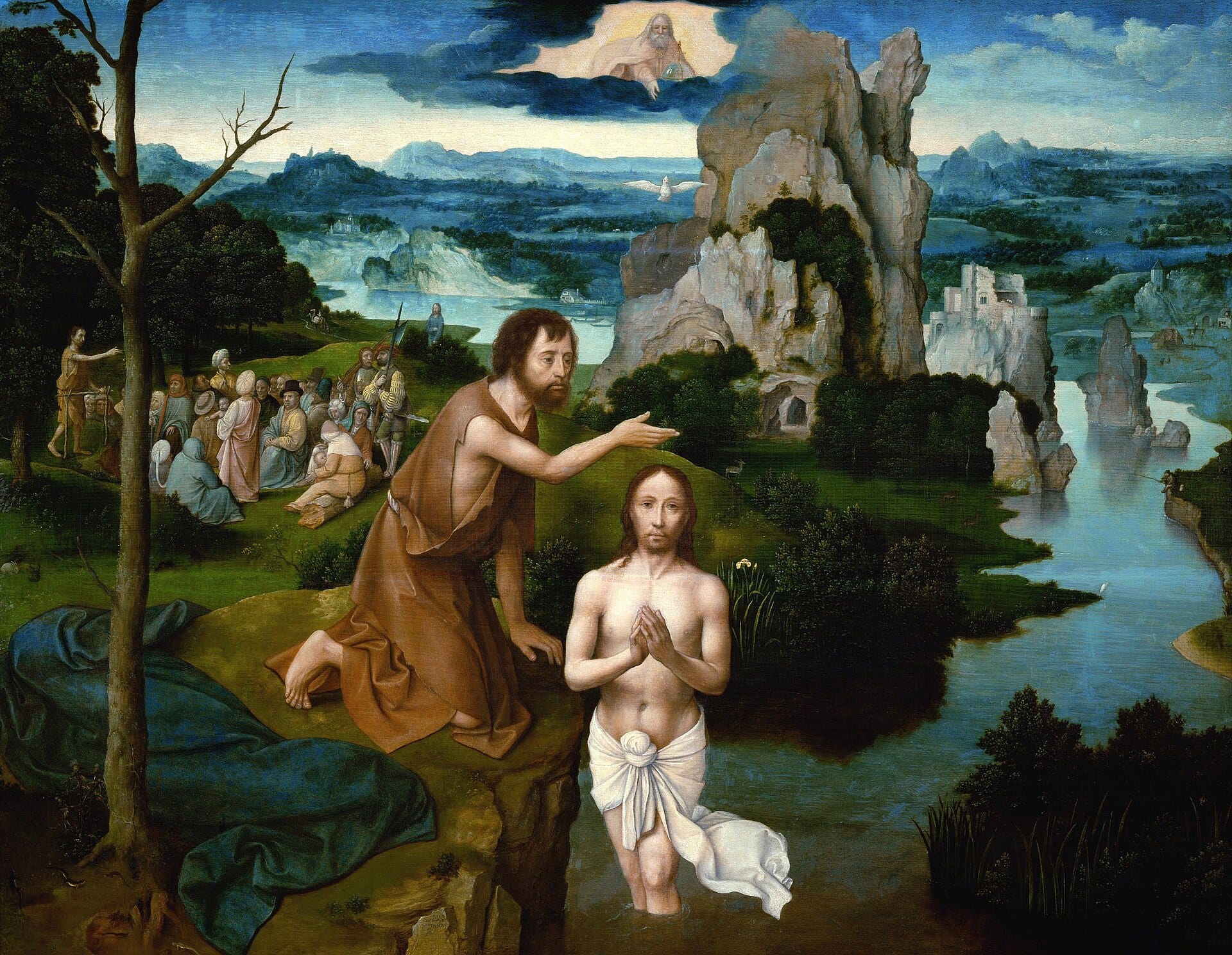
The Baptism of the Lord
Today, let us reflect on our own baptism and how we are adopted and reborn of water and the Holy Spirit. The following is an excerpt from a homily by Pope Benedict XVI (January 9, 2011)
According to the account of the Evangelist Matthew (Mt 3,13-17), Jesus came from Galilee to the River Jordan to be baptized by John; indeed people were flocking from all over Palestine to hear the preaching of this great Prophet and the proclamation of the coming of the Kingdom of God and to receive Baptism, that is, to submit to that sign of penance which calls for conversion from sin.
Although it was called “Baptism” it did not have the sacramental value of the rite we are celebrating today; as you well know, it was actually with his death and Resurrection that Jesus instituted the sacraments and caused the Church to be born. What John administered was a penitential act, a gesture of humility to God that invited a new beginning: by immersing themselves in the water, penitents recognized that they had sinned, begged God for purification from their sins and were asked to change wrong behavior, dying in the water, as it were, and rising from it to new life.
For this reason, when John the Baptist saw Jesus who had come to be baptized queuing with sinners he was amazed; recognizing him as the Messiah, the Holy One of God, the One who is without sin, John expressed his consternation: he, the Baptist, would himself have liked to be baptized by Jesus. But Jesus urged him not to put up any resistance, to agree to do this act, to do what is fitting “to fulfill all righteousness”.
With these words Jesus showed that he had come into the world to do the will of the One who had sent him, to carry out all that the Father would ask of him. It was in order to obey the Father that he accepted to be made man. This act reveals, first of all, who Jesus is: he is the Son of God, true God as the Father; he is the One who “humbled himself” to make himself one of us, the One who was made man and who accepted to humble himself unto death on a cross (cf. Ph 2,7).
The Baptism of Jesus, which we are commemorating today, fits into this logic of humility and solidarity: it is the action of the One who wanted to make himself one of us in everything and who truly joined the line of sinners; he, who knew no sin, let himself be treated as a sinner (cf 2Co 5,21), to take upon his shoulders the burden of the sin of all humanity, including our own sin. He is the “servant” of Yahweh of whom the Prophet Isaiah spoke in the First Reading (cf. Is 42,1). His humility is dictated by the desire to establish full communion with humanity, by the desire to bring about true solidarity with man and with his human condition.
Jesus’ action anticipates the Cross, his acceptance of death for man’s sins. This act of abasement, by which Jesus wanted to comply totally with the loving plan of the Father and to conform himself with us, expresses the full harmony of will and intentions that exists between the Persons of the Most Holy Trinity. For this act of love, the Spirit of God revealed himself and descended to alight upon Jesus as a dove, and at that moment the love which unites Jesus to the Father was witnessed to all who were present at the Baptism by a voice from Heaven that everyone heard.
© 2026 Lawain McNeil. All rights reserved
The Eastern Rites celebrate Theophany: Baptism, Magi and Cana and from their liturgy:
"Today the Bridegroom claims his bride, the Church, since Christ has washed her sins away in Jordan’s waters; the Magi hasten with their gifts to the royal wedding; and the wedding guests rejoice, for Christ has changed water into wine, alleluia."
What an Amazing Savior we serve! Thanks for sharing, Lawain...