


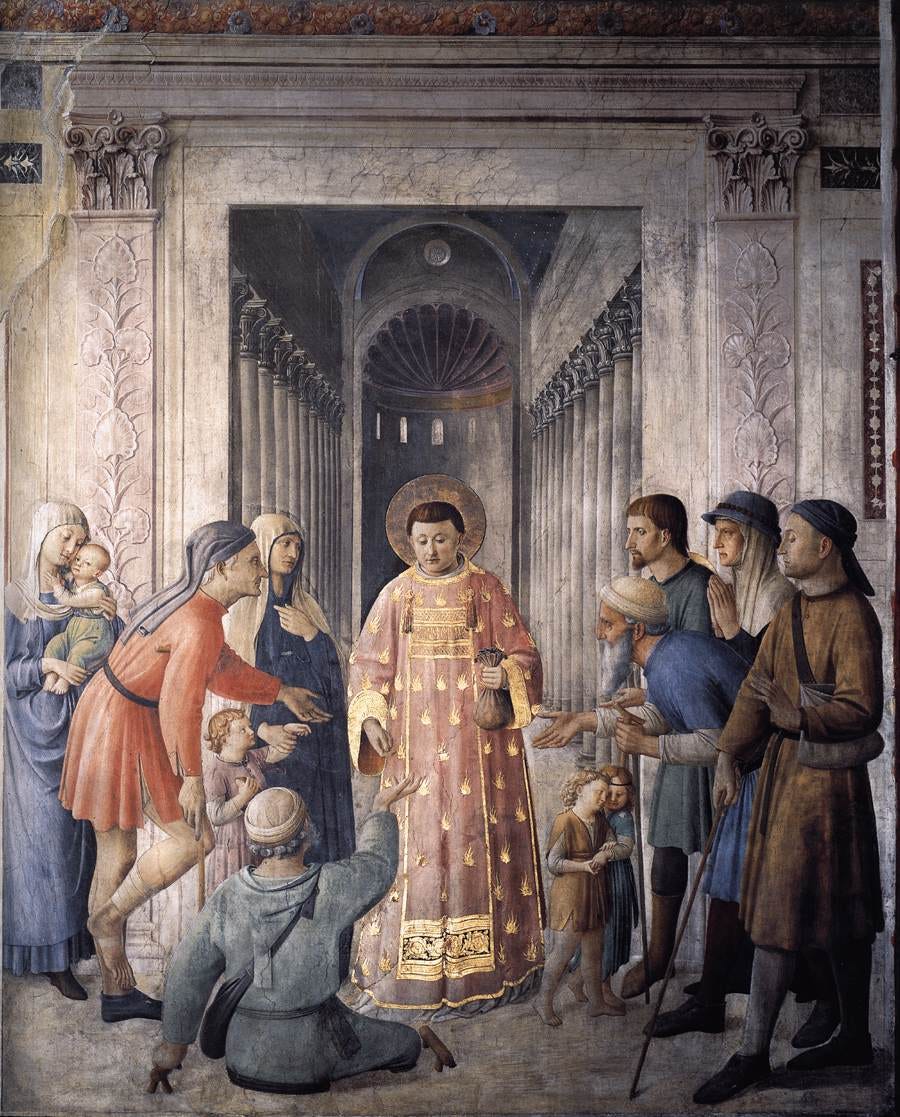
Today is Sunday, and I am a permanent deacon of the Catholic Church. Besides diaconating at two Masses today, I will be bringing Holy Communion to Catholic residents in two nursing homes. It is an ancient practice, described by St Justin Martyr in his First Apology (AD 155):
But we, after we have thus washed him who has been convinced and has assented to our teaching, bring him to the place where those who are called brethren are assembled, in order that we may offer hearty prayers in common for ourselves and for the enlightened person, and for all others in every place, that we may be counted worthy, now that we have learned the truth, by our works also to be found good citizens and keepers of the commandments, so that we may be saved with an everlasting salvation. Having ended the prayers, we salute one another with a kiss. There is then brought to the presider of the brethren bread and a cup of wine mixed with water, and he taking them, gives praise and glory to the Father of the Universe, through the name of the Son and of the Holy Spirit, and offers thanks at considerable length for our being counted worthy to receive these things at His hands. And when he has concluded the prayers and thanksgivings, all the people present express their assent by saying “Amen.” This word “Amen” in the Hebrew language means γένοιτο (so be it). And when the presider has given thanks, and all the people have expressed their assent, those who are called by us “deacons” give to each of those present to partake of the bread and wine mixed with water over which the thanksgiving was pronounced, and to those who are absent they carry away a portion.
And the wealthy among us help the needy, and we always keep together. And for all things wherewith we are supplied, we bless the Maker of all through His Son Jesus Christ, and through the Holy Spirit. And on the day called Sunday, all who live in cities or in the country gather together to one place, and the memoirs of the apostles or the writings of the prophets are read, as long as time permits. Then, when the reader has ceased, the presider verbally instructs and exhorts us to the imitation of these good things. Then we all rise together and pray, and, as we before said, when our prayer is ended, bread and wine and water are brought, and the presider in like manner offers prayers and thanksgivings, according to his ability, and the people assent, saying “Amen.” And there is a distribution to each, and a participation of that over which thanks have been given, and to those who are absent a portion is sent by the deacons. And they who are well to do, and willing, give what each thinks fit, and what is collected is deposited with the presider, who aids the orphans and widows and those who, through sickness or any other cause, are in want, and those who are in bonds and the strangers sojourning among us, and in a word takes care of all who are in need.
Since becoming a deacon I have visited and spent a great deal of time in many local nursing homes over the years, a few of which are comfortable and well-staffed, but most of which are rather stark and under-staffed. Many of the nursing homes are in poor neighborhoods. Many people there are lonely and waiting to die. They often tell me that they don’t know why they are still alive. Many of them are in very poor health and praying to die. I often wonder whether I am giving someone his or her last Communion. It is not unusual that when I go back the following Sunday a person to whom I gave Communion has passed away during the week. Some nursing homes allow pets, and their presence is no small consolation to many residents. As one elderly woman told me, “My little dog is my only real companion now. But he loves me and wants to be with me. My family doesn’t really want to be with me anymore. But this little dog and I are still together and keep each other company.” I understand what she meant, and I have difficulty finding anyone willing to go with me for my weekly nursing home visits and Communion calls. It is depressing.
Deacons are simply volunteers and are not paid for their ministry. Like the laity, they offer their Christian service without financial compensation, just for the joy of it and for a heavenly reward. As an examination of conscience, however, I must ask myself, “Do I really want to spend time with the people to whom I bring Holy Communion, or am I just doing my job and hoping that it does not seriously cut into my free time? Does this ministry give me joy, or is it just another chore? Do I empathize with the sufferings of the residents, or am I indifferent to their complaints? Am I present and attentive to them as a minister, or am I thinking about more enjoyable things that I wish I were doing at home with my own family or friends?” As a Catholic deacon, I bring people to Christ, and I bring Christ to people. That simple activity is what Christ has called me to do, but am I doing it joyfully, or merely out of a sense of obligation? Is my motivation adequate? Am I radiating peace and joy to others as I minister to them, or am I irritated with them because they are taking up too much of my time? When I arrive at home tired and need to take a nap, is my tiredness content and happy because I have served Christ and his people well, or am I just happy to be done with them and their overwhelming problems? The older I get, the more I am convinced that radiating peace and joy is the key to effective ministry. Trying to be a minister without the ability to find authentic peace and joy in your activities does more harm than good, but that does not mean that such a person should leave the ministry, any more than a married person should leave a joyless marriage. Many clergy leave the ministry because they are unable to find any joy in it, but it is always possible to rediscover the joy of charity and sacrifice, especially with the help of grace and a good spirituality.
Like marriage, ministry is a virtue, and virtues and vices are related to pleasures and pains. A virtuous person is one who finds pleasure and delight in activities that are noble, generous, and perfective. A person who lacks virtue in a certain area is one who subjectively feels pain or is unable to take pleasure in a particular activity that is objectively good in itself. For example, a temperate person is one who finds pleasure in abstinence and is thus inclined toward it, and an intemperate person is one who finds pain in abstinence and is thus inclined not to abstain. A brave person is one who faces a necessary danger with pleasure and is thus inclined to meet the challenge, and a cowardly person is one who faces danger with pain and is thus inclined to flee. A musical person is one who finds pleasure in performing and hearing good music. A studious person is one who finds pleasure in learning. An intellectual person is one who finds delight in understanding. A charitable person is one who finds delight in giving; and so on, for every virtue. If a minister is unable to find joy and delight in the fulfillment of his ministry, then for some reason he temporarily lacks the virtue of ministry, and he needs to undergo a transformation of his values, motivations, and attachments. Pope Francis understood this ministerial requirement well, as he explained in his Apostolic Exhortation Evangelii Gaudium (2013):
81. At a time when we most need a missionary dynamism which will bring salt and light to the world, many lay people fear that they may be asked to undertake some apostolic work and they seek to avoid any responsibility that may take away from their free time. For example, it has become very difficult today to find trained parish catechists willing to persevere in this work for some years. Something similar is also happening with priests who are obsessed with protecting their free time. This is frequently due to the fact that people feel an overbearing need to guard their personal freedom, as though the task of evangelization was a dangerous poison rather than a joyful response to God’s love which summons us to mission and makes us fulfilled and productive. Some resist giving themselves over completely to mission and thus end up in a state of paralysis and acedia.
82. The problem is not always an excess of activity, but rather activity undertaken badly, without adequate motivation, without a spirituality which would permeate it and make it pleasurable. As a result, work becomes more tiring than necessary, even leading at times to illness. Far from a content and happy tiredness, this is a tense, burdensome, dissatisfying and, in the end, unbearable fatigue. This pastoral acedia can be caused by a number of things. Some fall into it because they throw themselves into unrealistic projects and are not satisfied simply to do what they reasonably can. Others, because they lack the patience to allow processes to mature; they want everything to fall from heaven. Others, because they are attached to a few projects or vain dreams of success. Others, because they have lost real contact with people and so depersonalize their work that they are more concerned with the road map than with the journey itself. Others fall into acedia because they are unable to wait; they want to dominate the rhythm of life. Today’s obsession with immediate results makes it hard for pastoral workers to tolerate anything that smacks of disagreement, possible failure, criticism, the Cross.
83. And so the biggest threat of all gradually takes shape: “the gray pragmatism of the daily life of the Church, in which all appears to proceed normally, while in reality faith is wearing down and degenerating into small-mindedness”. A tomb psychology thus develops and slowly transforms Christians into mummies in a museum. Disillusioned with reality, with the Church and with themselves, they experience a constant temptation to cling to a faint melancholy, lacking in hope, which seizes the heart like “the most precious of the devil’s potions”. Called to radiate light and communicate life, in the end they are caught up in things that generate only darkness and inner weariness, and slowly consume all zeal for the apostolate. For all this, I repeat: Let us not allow ourselves to be robbed of the joy of evangelization!
About Deacon Tracy Jamison, OCDS, PhD
Deacon Tracy Jamison was raised in a Christian family as the son of a Scotch-Irish evangelical minister in the Campbellite tradition. As an undergraduate he majored in Biblical and Ancient Near Eastern Studies at Cincinnati Christian University, where his parents had been educated. At this institution he met Joyce, who was completing a degree in Church Music, and after graduation they entered the covenant of Christian marriage in 1988. Through the study of philosophy and the writings of the Early Church Fathers, Tracy was received into the full communion of the Catholic Church in 1992. Under the influence of the theological writings of St. John Paul II he began to study the works of St. Teresa of Avila and St. John of the Cross and entered formation as a Secular Carmelite of the Teresian Reform. In 1999 he completed the doctoral program in Philosophy at the University of Cincinnati, and in 2002 he made his definitive profession as a Secular Carmelite. In 2010 he was ordained as a permanent deacon of the Archdiocese of Cincinnati. Currently he is an associate professor of philosophy at Mount St. Mary’s Seminary of the West.
© 2026, Lawain McNeil, Mission Surrender, LLC.