


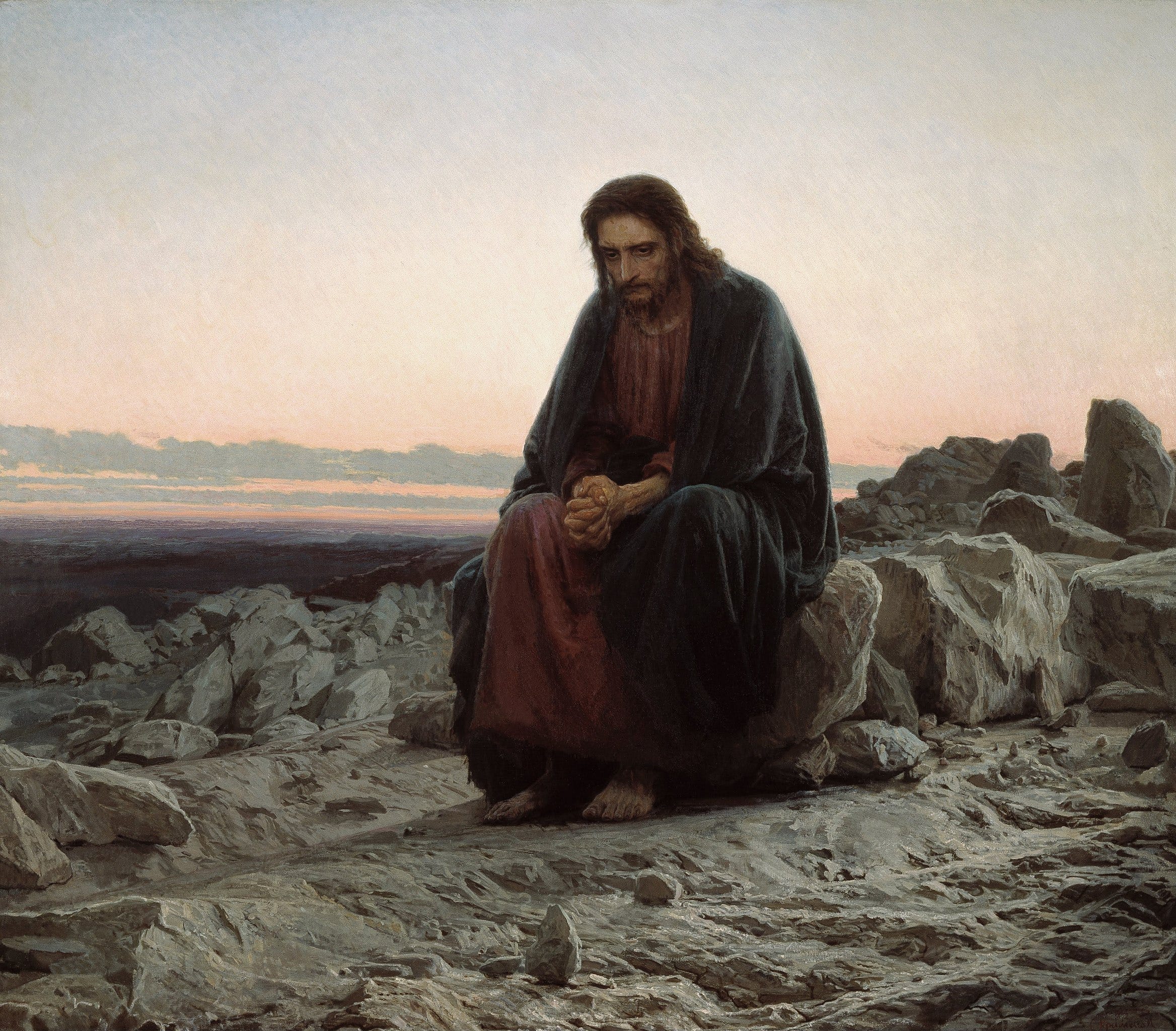
In Year A of the Lectionary cycle, the Gospel for the First Sunday of Lent is the Temptation of Jesus in the desert (Matthew 4:1–11). When I read this Gospel, it always brings to mind Fr. Smith, the protagonist of Walker Percy’s The Thanatos Syndrome. Fr. Smith is an odd character. He is not unlike many of the saints we read about, particularly the early desert fathers of the Church. These early saints practiced what we would consider strange, even severe, asceticism. A Syrian monk by the name of Saint Simeon the Stylite is one such saint. Percy, in fact, models Fr. Smith after Simeon in his novel.
Saint Simeon the Stylite lived atop a narrow platform sixty feet in the air for thirty-seven years, with only a basket lowered for provisions. It was his way of practicing penance: praying, fasting, and bowing in prostration before God. It reminds me of those who built the Tower of Babel. These early technocrats rebelled against God, straining upward to compete with the One who created them. Saint Simeon climbed his tower for precisely the opposite reason: to detach from the world, to crush the pride within him, to come before God with nothing left to hide behind.
Fr. Smith, like Saint Simeon, does not climb a pillar but a fire lookout tower. This is his modern pillar, where he watches, prays, and does penance for a broken world. And the world Fr. Smith inhabits is our world. It is a world adrift in atheistic scientism, spiritual emptiness, and technological drunkenness. Both men embrace voluntary suffering as a means of reparation. They are not attempting to fix the world through systems or ideology. They are trying to conquer it from within; through their own renunciation, through the slow dying to the lust of the flesh, the lust of the eyes, and the pride of life (1 John 2:16).
Yesterday’s Gospel shows us why this matters so deeply. They are the three fundamental disorders that still unravel human hearts today. When Satan offers bread to a starving Jesus, it is the temptation to place the needs of the body above the will of the Father. When he spreads out all the kingdoms of the world, it is the temptation toward wealth, power, and possession. And when he urges Jesus to throw himself from the parapet so the angels might catch him, it is the temptation toward recognition and glory from men. Jesus refuses each one. He knows that genuine Messiahship does not come by shortcuts but comes by the Cross. And he knows that glory comes from God alone.
The early Church Fathers saw in all of this the figure of the New Adam. Unlike Adam, who abused the freedom God gave him, Jesus was obedient and in his obedience, restored what had been lost. He fulfilled Israel’s vocation perfectly, the vocation Israel could never manage on its own. Jesus makes all things new (Revelation 21:5)! Thanks be to God.
This is why Lent is not merely a spiritual exercise. It is a genuine participation in Christ’s own victory in the desert. By fasting, praying, and giving alms, we enter the same battle Jesus entered and we enter it with him.
Last week we reflected on Psalm 121. This was the Psalm of Ascent that was sung on the road up to Jerusalem. The terrain was dangerous. Its promise is simple and strong: “The Lord will keep your going out and your coming in from this time forth and for evermore.” (Ps. 121:8). Whether Simeon on his pillar, Fr. Smith on his tower, or each of us in our own desert, Christ watches over us. Christ walks with us.
© 2026, Lawain McNeil, Mission Surrender, LLC.
Thank YOU, LORD JESUS, for watching over me & walking with me. Thanks, Lawain, for this devo!