


We are all called to perfect union with God through Christ. “Be perfect,” Christ tells us, “as your heavenly Father is perfect” (Matthew 5:48).
The Greek word τέλειός, often translated “perfect,” carries the sense of being complete and is analogical or relative to one’s nature.
Our desire for perfection may be good or evil. What is the difference between desiring the perfection or completion of spiritual union with God and desiring instead the perfection of never making any mistakes or doing anything wrong?
In the former kind of desire we are convinced and peacefully accept that we have limited powers and make mistakes necessarily by nature, even apart from sin. We thus are content with our finitude.
In the true way of perfection we are happy that we essentially are not God and are not essentially good, and by grace we are striving to do his will. We are happy that we are only human and only contingently good. We desire to be one with God only contingently, not essentially. We do not divinize ourselves and our own judgments and desires. We habitually practice self-accusation and self-abnegation.
But the other kind of desire—the desire never to be in error—is the desire to be God essentially. Such a desire is a product of the original sin which rejects God’s will and self-divinizes one’s self and one’s own will. It is the intellectual desire that also led to the fall of the angels.
In the false way of perfection we cannot stand to be wrong, and thus we habitually practice self-justification and self-affirmation.
In the true way of perfection we are happy to be wrong, to be weak, to try and fail and try again, and to be recognized as imperfect. Indeed, we are even happy to be misjudged and to have our virtues overlooked, as Christ was.
In order to advance along the true way of perfection, we must receive the grace of infused contemplation and pass through the dark night of the senses and the dark night of the spirit, described by St John of the Cross (1542-1591) and other Christian saints and mystics. The dark nights are levels of participation in the Cross of Christ. They are similar to a long slow martyrdom and dying to self.
When asked what form this martyrdom takes, St Jane Frances de Chantal (1572-1641) answered:
“Yield yourself fully to God, and you will find out! Divine love takes its sword to the hidden recesses of our inmost soul and divides us from ourselves. I know one person whom love cut off from all that was dearest to her, just as completely and effectively as if a tyrant’s blade had severed spirit from body.”
“From the moment when we commit ourselves unreservedly to God, until our last breath, we suffer the martyrdom of love. I am speaking, of course, of great-souled individuals who keep nothing back for themselves but instead are faithful in love. Our Lord does not intend this martyrdom for those who are weak in love and perseverance. Such people he lets continue on their mediocre way, so that they will not be lost to him. He never does violence to our free will.”
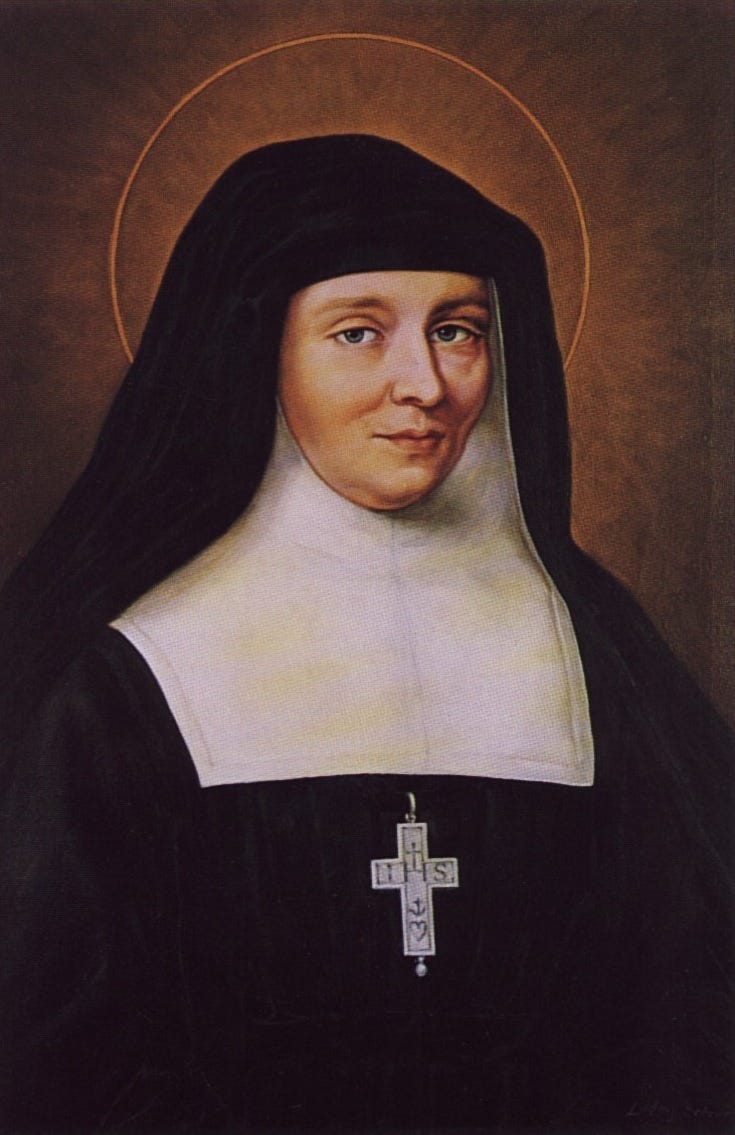
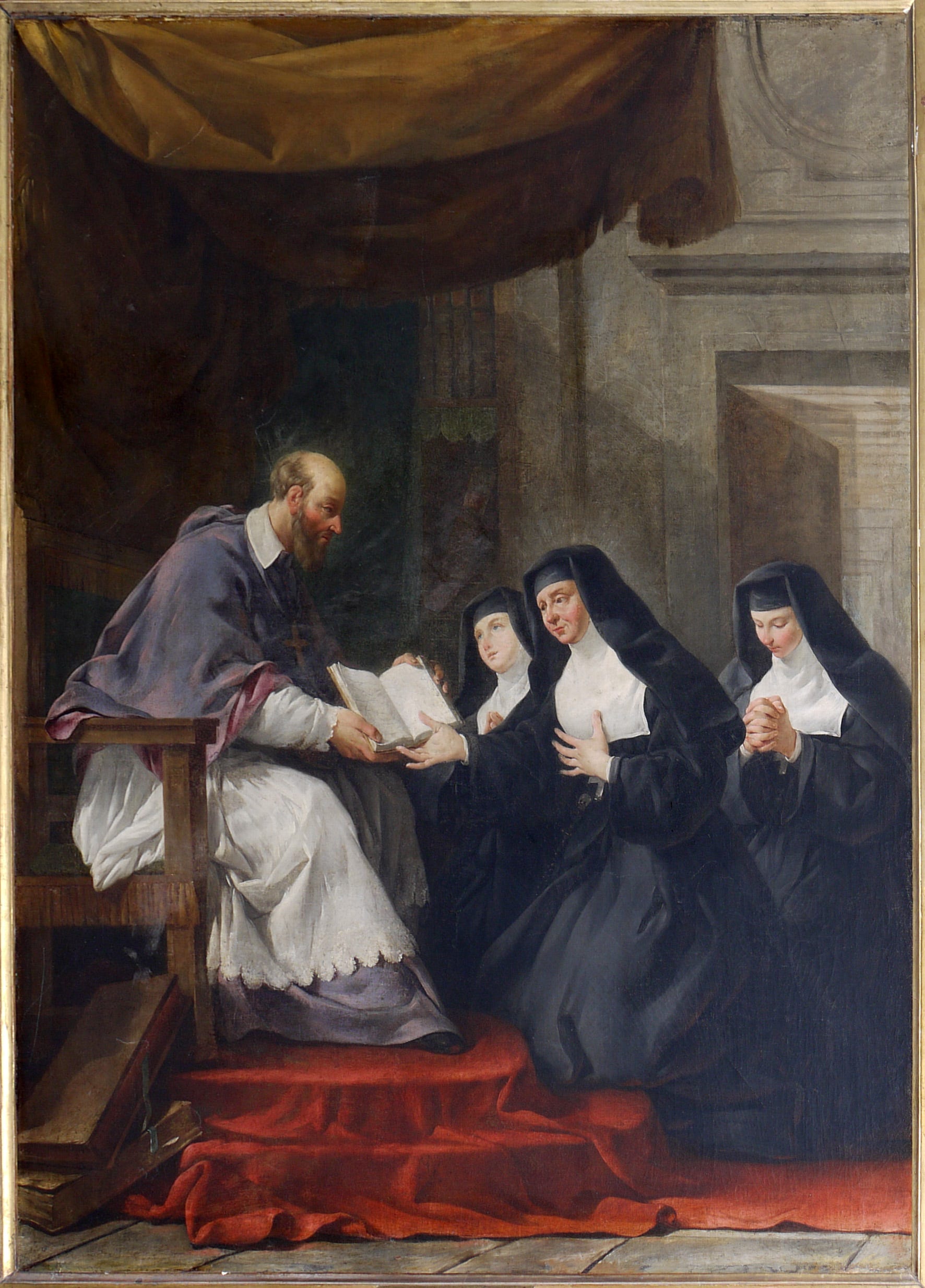
Born in Dijon, France, St Jane Frances de Chantal was a Christian saint who received good spiritual instruction and direction from St Francis de Sales (1567-1622) and possessed the courage and generosity to pursue the way of perfection to its completion.
She committed herself unreservedly to God and kept nothing back for herself. She persevered in the practice of charity and passed through the dark nights of the soul. She surrendered herself completely to the will of God and suffered greatly in union with Christ.
Her mother had died when she was only 18 months old. At the age of 21 years old, she married Baron de Chantal. They had six sons, and three of them died young.
She was habitually generous to the poor and the sick. After only seven years of marriage, her husband was killed in a hunting accident, and she struggled to forgive the man who was responsible.
She was forced to move in with her father-in-law, an unkind man, but she bore the difficult circumstances with love and patience.
She sank into grief and deep dejection for four months, overwhelmed by the loss of her husband. She faced many periods of illness and experienced interior anguish and spiritual dryness.
She raised and provided for her remaining sons and then entered religious life.
Amid great opposition and resistance, she founded the Visitation Order and worked tirelessly during the plague to help the victims, putting her convent at their disposal.
Many of her companions and friends died, including her director St Francis de Sales. There was nothing weak or mediocre about her love and perseverance.
What about us? The way of perfection is open for us, but do we have the courage and generosity to take it?
Do we ask God to help us grow in holiness, or do we prefer to continue on our mediocre way?
Do we abandon ourselves to divine providence, or do we keep many things back for ourselves?
In her first apparition (May 13, 1917), Our Lady of Fatima asked the shepherd children, Lucia, Francisco, and Jacinta, “Do you wish to offer yourselves to God to endure all the sufferings that He may be pleased to send you, as both an act of reparation for the sins with which He is offended and an act of supplication for the conversion of sinners?”
Lucia responded for all three of them, “Yes, we do.” And Our Lady said, “Well then, you will have much to suffer. But the grace of God will be your comfort.” Immediately her words began to come true in their lives.
Are you a faithful Christian who is continually faced with many trials, tribulations, and sufferings? Have you already been given much to suffer?
Then consider that by this means God is working for your perfection and completion. He is calling you to sainthood. He does not want you to be weak and mediocre.
If you respond with love and generosity and surrender yourself completely to the will of God, then the grace of God will be your comfort. And there is no greater comfort.
By the grace of God, you will grow in holiness. You will become strong and heroic in union with the Cross of Christ.
You will be a blessing to your loved ones and even to people whom you have never met.
Like St Paul, in your challenges and in your flesh you will “complete what is lacking in Christ’s afflictions for the sake of his body, that is, the Church” (Colossians 1:24).
May the prayers of the Blessed Virgin Mary, St Jane Frances de Chantal, and the shepherd children of Fatima help us to offer ourselves unreservedly to God and say “Yes” as they did.
COLLECT
O God, who made Saint Jane Frances de Chantal
radiant with outstanding merits in different walks of life,
grant us, through her intercession,
that, walking faithfully in our vocation,
we may constantly be examples of shining light.
Through our Lord Jesus Christ, your Son
who lives and reigns with you in the unity of the Holy Spirit,
God, for ever and ever. Amen.
© 2026, Lawain McNeil, Mission Surrender, LLC.
Thanks Lawain. Appreciate your faithful work on this. Very helpful.