


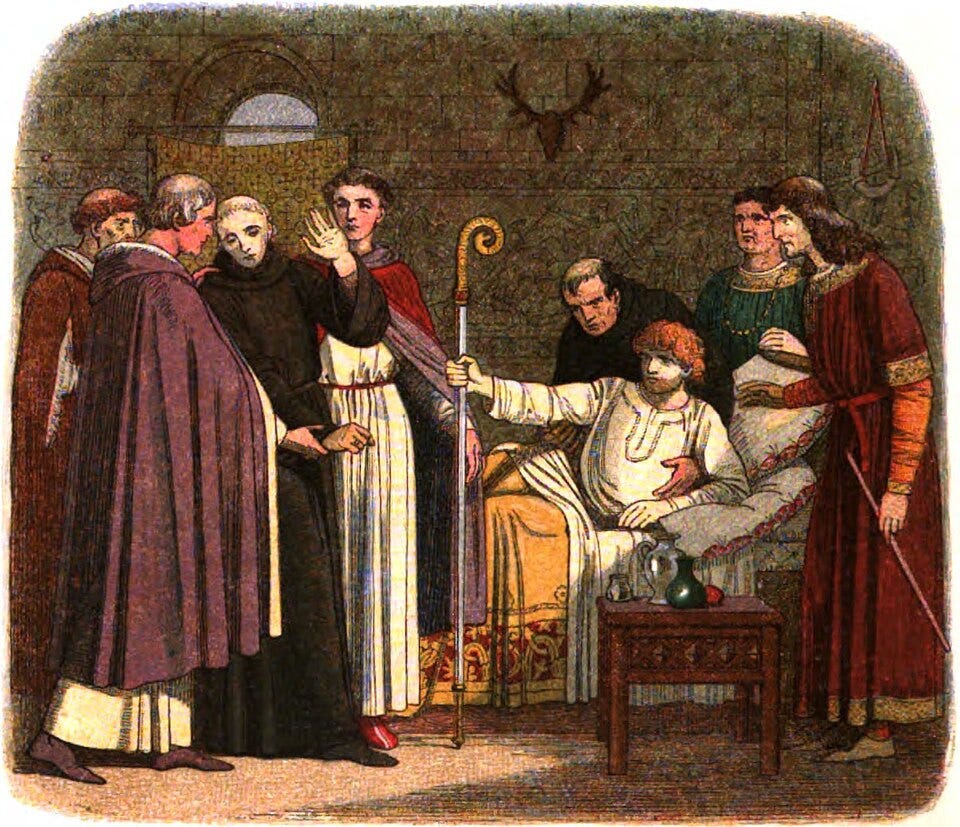
Today is a post from Deacon Tracy Jamison, OCDS, PhD. Deacon Jamison is a Catholic Philosopher. It is a long read, but well worth the effort. Grab some coffee, a quiet place, and ask for the intercession of Saint Anselm, as we explore Saint Anselm’s ontological argument for the existence of God.
Anselm was born in Aosta, in northern Italy, and became a monk of Bec in Normandy, where he taught theology and devoted himself to the spiritual life. After some years as abbot, he succeeded his master Lanfranc as archbishop of Canterbury. His bitter disputes with the kings of England over the independence of the Church resulted in his twice being exiled. He died at Canterbury on 21 April 1109. He is remembered for his theological learning and writings, and for organising and reforming church life in England.
Source: Universalis
Chapter II of St Anselm’s Proslogion
Deacon Jamison, OCDS, PhD
St Anselm’s so-called “ontological” argument for the existence of God (in Chapter II of the Proslogion) was clearly refuted by St Thomas Aquinas in several texts, though Anselm’s other arguments were recognized as sound. Immanuel Kant’s well-known criticisms of the ontological argument were simply repeating what St Thomas had already said about it. Thomists developed several lines of criticism against it, as they did against all a priori arguments for the existence of God. They pointed out that any argument that attempts to infer actual existence from conceptual existence commits the fallacy of equivocation by an invalid shift in supposition.
Some modern Catholic philosophers have defended St Anselm’s argument as presupposing mystical experience of the existence of God through prayer, rather than as attempting to prove God’s existence by reason alone, but the medieval philosophers did not interpret the argument in that manner. And traditional Thomists have kept pointing out that even in the mystical experience of God our knowledge of God is necessarily indirect. In order to infer God’s actual existence from God’s essence, we would first have to know the essence of God directly in itself, which is impossible in this life. Only in the Beatific Vision in heaven will we possess such knowledge and happiness.
Some commentators, Karl Barth for example, seem to argue along the following lines (here summarized):
Thomists reject St Anselm’s ontological argument for the existence of God specifically because they have a different understanding of the relation of thought to existence than that held by St Anselm and others. St Anselm’s main conclusion seems to be that God cannot be thought not to exist (hence, the “fool” says in his heart that there is no God). If this realization constitutes an answer to his prayer in the first chapter, then we are dealing with something along the lines of Platonic anamnesis. Hence, the “argument” (or better, the “prayer”) is more a matter of the mind utilizing reason to find the memory or trace of its Creator in itself and experiencing the intuition that rationally flows from that recovery. This would make sense of St Anselm’s quest of faith seeking understanding in a unique way of immanence. He is presupposing the existence of God in faith. The one who believes and follows the argument or prayer is thereby given an understanding of the necessity of God’s existence, but the foundation of this understanding is the grace of rational certainty infused in the human intellect by God. The human intellect is in a supernatural participatory relationship with God through the infused virtue of faith. (See Etienne Gilson, “The Meaning and Nature of St Anselm’s Argument.”)
In Chapter I of the Proslogion, St Anselm encourages us to pray to God as follows:
Up now, slight man! Flee, for a little while, thy occupations; hide thyself, for a time, from thy disturbing thoughts. Cast aside, now, thy burdensome cares, and put away thy toilsome business. Yield room for some little time to God; and rest for a little time in him. Enter the inner chamber of thy mind; shut out all thoughts save that of God, and such as can aid thee in seeking him; close thy door and seek him. Speak now, my whole heart! Speak now to God, saying, I seek thy face; thy face, Lord, will I seek (Psalms 27:8).
Teach me, O Lord, to seek thee, and reveal thyself to me, when I seek thee, for I cannot seek thee, except thou teach me, nor find thee, except thou reveal thyself. Let me seek thee in longing, let me long for thee in seeking; let me find thee in love, and love thee in finding.
Lord, I acknowledge and I thank thee that thou hast created me in this thine image, in order that I may be mindful of thee, may conceive of thee, and love thee; but that image has been so consumed and wasted away by vices, and obscured by the smoke of wrong-doing, that it cannot achieve that for which it was made, except thou renew it, and create it anew. I do not endeavor, O Lord, to penetrate thy sublimity, for in no wise do I compare my understanding with that; but I long to understand in some degree thy truth, which my heart believes and loves. For I do not seek to understand that I may believe, but I believe in order to understand. For this also I believe, --that unless I believed, I should not understand. (Works of St Anselm, translated by Sidney Norton Deane, 1903)
Against the modern or Barthian line of interpretation, which still remains very much a minority opinion, most commentators take Anselm’s so-called ontological argument out of the theological context of faith and prayer and believe that it simply goes like this:
God is the greatest conceivable being, i.e. that being than which nothing greater can be conceived. But if (contrary to fact) he did not actually exist, then he would not be the greatest conceivable being, since we would be able to conceive a greater being, viz. one who actually existed. Thus, just from the fact that supposing that God lacks actual existence entails a contradiction, it follows by reduction to the absurd that God must actually exist.
In other words, God must actually exist, because actual existence uniquely belongs to the concept of God. It is true that God must exist, but St Anselm’s argument in Chapter II of the Proslogion seems to lack a good reason why this is so. The argument appears to be a fallacious oversimplification, because even though it is true that actual existence uniquely belongs to the concept of God, it is nevertheless logically possible that God exists not actually but only conceptually (in the mind, so to speak).
The fallacy can be described in various ways. Here are two ridiculous arguments that commit the same fallacy as Anselm’s ontological argument for the existence of God: (1) “Horse is a species, and Seabiscuit is a horse, therefore Seabiscuit is a species.” (2) “Humans subsist (by virtue of their immortal souls), and Santa Claus is a human, therefore Santa Claus subsists.” The first argument equivocates on the term “horse” signifying either a concept or an actual individual. The second argument is one that I made up to illustrate the fact that even when subsistence is a necessary element of a thing’s nature, it still does not follow that the thing actually exists. Only if the modern character of Santa Claus were an actual human person would his soul actually subsist.
These two arguments are not completely analogous to Anselm’s ontological argument, but they are unsound for the same reason. From the fact that the concept of God as the greatest conceivable being necessarily includes actual existence, it does not follow that God actually exists. Attempting to infer actual being from mental being is a confusion between that which is true simpliciter (absolutely) and that which is true secundum quid (in a certain sense). Actual being necessarily follows in a conclusion only if it is already present in the premises. And if the actual existence of God is implicitly assumed in the premises of an argument for the existence of God, then the argument begs the question. The fallacy in Anselm’s ontological argument is therefore a material fallacy, not a formal fallacy. The argument either contains an equivocation or begs the question, depending on what exactly the speaker is asserting.
In general, from the order of ideas alone, we cannot validly infer anything about the order of actuality. All sound arguments for the existence of God or the Uncaused Cause must therefore be a posteriori. This is an Aristotelian principle that Dominican theology after Aquinas consistently defended. Anselm had taken the existence of God as self-evident and then supposed that the denial of the existence of God was incoherent in itself a priori, even without recourse to truths known a posteriori. This line of reasoning assumes that being known in itself is the same as being known to us. But the assumption is problematic, as Aristotle pointed out, and Aquinas explicitly invoked Aristotle’s distinction against Anselm’s novel Proslogion argument.
Sometimes the subject of a proposition necessarily does contain the predicate of the proposition, thus making the proposition conceptually true, and yet the truth of the proposition might not be immediately known to everyone, since some people lack sufficient knowledge of the subject. Take, for example, the proposition “Water is H2O.” If we innately had sufficient knowledge of the essence of water, we could just recollect (by anamnesis) and examine the contents of that knowledge, thus demonstrating to ourselves that water is H2O. But we do not innately have sufficient knowledge of the essence of water, so we must demonstrate to ourselves that water is H2O by reasoning from truths which are naturally more known to us. Similarly, Anselm, in order to make his ontological argument for God’s existence valid, had to assume that we already have innate or infused knowledge of God’s essence and just need to remember what we already know about God.
Every time in the history of philosophy someone advances the ontological argument, others who reflect on it raise the objection, “It is true that the greatest conceivable being must be conceived as having actual existence, but it does not follow that there is anything in reality that actually corresponds to this concept.” The existence of created material things is naturally more known to us than the existence of God is known to us, so we must reason to God’s existence from what he has created and made naturally known to us. Anselm’s famous line of reasoning works only on the assumption that we actually possess innate, intuitive, or infused knowledge of God’s essence. As we noted above, some theologians (e.g. Karl Barth) defend Anselm’s line of reasoning as presupposing the content of faith, but if Anselm’s reasoning is based on faith, then it accepts on the basis of testimony the very truth that it attempts to prove on the basis of reason, and thus it begs the question. This defense seems inadequate and misguided, especially since Anselm himself does not use it in reply when his contemporary Gaunilo of Marmoutiers interprets the argument in Chapter II of the Proslogion as based on reason alone.
Aquinas maintains that the existence of God can be demonstrated by reason alone, not a priori, but only from truths which are more known to us a posteriori. This approach does not beg the question. And for Aquinas, whatever is demonstrated and thus known by reason alone is no longer an object of faith per se. The truths of the faith per se are truths which transcend human reason and are thus not subject to rational demonstration. It seems to me that Aquinas in effect says to Anselm, “The novel argument that you give in Chapter II of the Proslogion is viciously circular, since it cannot make the existence of God known to us without assuming that the existence of God is already known to us either by faith or by reason. The existence of God can certainly be made known to us by faith, but the specific question is whether it can also be made known to us by reason alone. And any purely rational demonstration of the existence of God which takes the existence of God as a premise already known to us by reason alone is unsound and unconvincing.”
Aquinas proposes instead that there is no good reason to suppose that we actually possess an innate or intuitive knowledge of the existence of God. Anselm needs to prove that we have such knowledge, if he is not simply begging the question by invoking the content of the faith. Aquinas has no such need, and he does not believe that there is any such proof. He believes instead that we infer and come to know the existence of God from the existence of the material universe. Aquinas therefore rejects Anselm’s argument in Chapter II of the Proslogion and reasons to God’s existence by appealing to truths that are known to us simply from our ordinary experience of the way things are. Anselm himself appeals to such truths in the Monologion. Anselm’s arguments are quite similar to arguments offered by Augustine in the 4th and 5th centuries and by Boethius in the 6th century. The writings of Augustine and Boethius deeply influenced both Anselm and Aquinas.
Note that there are at least five different texts by Aquinas which are relevant to his evaluation of Anselm’s so-called ontological argument for the existence of God:
Commentary on the Sentences of Peter Lombard, Book I, Distinction 3, Question 1, Article 2
Disputed Questions on Truth, Question 10, Article 12
Summa Contra Gentiles, Book I, Chapter 11
Summa Theologiae, First Part, Question 2, Article 1
Commentary on De Trinitate of Boethius, Question 1, Article 3
If the Barthian or modern line of interpretation is correct, then Anselm’s ontological argument belongs to the phenomenological and subjective order of ideas, not to the metaphysical and objective order of essences, which is ironic given that it is called the ontological argument. As a dialectical form of prayer, such reasoning about the content of our ideas toward a better understanding is very helpful. Phenomenology and prayer are related forms of dialectical recollection (anamnesis). Prayer is the recollection of the mind, memory, and heart toward God in faith, hope, and charity. Like faith, prayer is a theological kind of virtue, but it resides in our conscious thoughts and desires. Just as the subjective self presupposes the objective soul, the subjective virtue of prayer presupposes the objective virtue of faith. It is a participation in God’s own knowledge, and it comes in degrees. It may be vocal, mental, or contemplative. It brings divine faith, hope, and charity to perfection. It tends towards looking and listening over speaking and petitioning. It facilitates a transformation of our thoughts and desires, so that we become preoccupied with the highest goods. Above all, through mental and contemplative prayer we become preoccupied with the presence of God. This activity of loving attention to God through faith, hope, and love is the highest human perfection.
Thomistic personalism is a synthesis of the medieval metaphysics of St Thomas Aquinas with the modern phenomenology of Edmund Husserl. Realist phenomenology maintains that the object of knowledge exists independently of our percepts, concepts, and conscious attendings and has an identity that transcends such acts of cognition and intuition. A Thomistic realist would maintain further that the object of knowledge has its own substantial and accidental forms which acquire an intentional mode of existence in being cognized, through which they can then be recognized or intuited. Pope St John Paul II (Karol Wojtyla), for example, insists that the intentionality of consciousness is not primary but secondary, and that phenomenology is a supplemental endeavor to recognize and understand intentions which have already been cognized fundamentally through percepts and concepts formed under the natural ontological attitude. See the arguments that he makes in The Acting Person.
Eidetic intuition should not be conflated with abstractive induction or divine illumination. The intuition attained dialectically through recollection in the phenomenological attitude is an indirect kind of knowledge produced by a reflexive act of identity synthesis. The entities thus known and formulated by phenomenological analysis are nevertheless formal identities, revealing and making explicit the necessary universals which are conceptualized directly in ordinary experience. Phenomenology operates in the order of second intentions, presupposing the intellect’s natural and spontaneous power to grasp the essences of things in the order of first intentions.
Phenomenology thus understood is a dialectical endeavor to recollect and understand explicitly and consciously that which we already know implicitly and unconsciously. It is indeed related to Plato’s dialectical method of recollection (anamnesis), but it clarifies and defines forms which exist in matter and are initially comprehended by a process of sensation, perception, abstraction, and induction. Forms impregnate the human faculties with percepts and concepts and can be grasped reflexively as acts having intentional content. In The Acting Person, John Paul II (Wojtyla) offers a workable synthesis of phenomenology with traditional Thomistic epistemology. Modern phenomenologists and transcendental Thomists who attempt to avoid or eliminate the scholastic postulation of impressed and expressed species as natural formal signs are necessarily left with an inadequate theory of meaning and truth, and they are sawing off the very branch on which they are sitting, so to speak.
Aristotelian scholasticism often opposes and attempts to suppress phenomenological existentialism, and modern phenomenological existentialism often opposes and attempts to suppress Aristotelian scholasticism. According to the synthesis of St John Paul II, the truth is that these two paradigms are not totally incommensurable, and any adequate anthropology must include both of them by holding them in continuity. John Paul II regards the antagonism as unnecessary, unfortunate, and counter-productive. The modern existentialist opposition to medieval faculty psychology is just as problematic as the Aristotelian opposition to modern existential psychology. We can grant that phenomenological existentialism can be a path toward sound metaphysics, but only when it remains adequately grounded in sound metaphysics. The lessons that Aristotle taught us must not be forgotten. The Aristotelian philosophical framework is not merely one scientific paradigm among many; rather, it is the prerequisite of scientific understanding itself. Those who abandon the realism of Aristotelian philosophy of science inevitably fall into pragmatism, idealism, or nominalism.
The synthesis of John Paul II facilitates a reconciliation between Anselm’s a priori ontological argument and Aquinas’s Five Ways to prove the existence of God a posteriori. Phenomenological and existential knowledge can be obtained when we reflexively direct our intellects to the dialectical recollection and conceptualization of our own subjective acts of sensing, perceiving, judging, understanding, valuing, remembering, imagining, and meaning. Our external and internal senses cannot sense their own acts, but our intellects by contrast are able to understand their own acts of understanding, along with our other acts of cognition, including those based on the infused content of faith, and thus we can recollect that content and formalize it in sciences of second intentions.
The unique reflexive power of the human intellect is what enables us to employ our memories and imaginations in the perfective mental activity of re-cognizing our own cognitions and re-evaluating our own valuations and attitudes in order to cultivate our comprehension and appreciation of truth, goodness, and beauty and to guide our practical and moral decisions and activities. Empirical and metaphysical knowledge is fundamental and objective, having no necessary dependence on phenomenological and existential knowledge, but by contrast phenomenological and existential knowledge is supplemental and subjective, always presupposing inductive empirical and metaphysical knowledge. Phenomenology can assist the empirical sciences and open a path to metaphysics, but it cannot replace or substitute for them.
The human person is essentially a potency for the actualization of two distinct but unified orders of being.
Co-essential principles always have a prior-posterior relation. The Catholic approach to philosophy is to distinguish in order to unify and integrate. Integration always requires the posterior to be congruent with the prior. As taught in traditional Carmelite anthropology and mystical theology, the human person has a cruciform constitution. Any adequate anthropology must distinguish the vertical and objective dimension of the human person from the horizontal and subjective dimension of the human person and must then unify and integrate them. Any lack of congruence is a disintegration of the human person. See Richard E. Dumont, OCDS, PhD, Commentary on the Writings of St John of the Cross: A Cruciform Mysticism and Christocentric Anthropology, https://www.amazon.com/Commentary-Writings-St-John-Cross/dp/1456497243/.
No demonstration of the existence of God is metaphysically neutral. All demonstrations of the existence of God objectively presuppose first principles such as the principle of non-contradiction, the principle of identity, the principle of sufficient reason, and the principle of finality. May the prayers of St Anselm of Canterbury and St Thomas of Aquino together come to the aid of modern culture, liberate it from the epistemological errors of pragmatism, idealism, and nominalism, and enable it to recover an understanding of the metaphysical principles which lead the human intellect to recognize the existence and goodness of God as the only adequate foundation of human happiness and authenticity.
About Deacon Tracy Jamison, OCDS, PhD
Deacon Tracy Jamison was raised in a Christian family as the son of a Scotch-Irish evangelical minister in the Campbellite tradition. As an undergraduate he majored in Biblical and Ancient Near Eastern Studies at Cincinnati Christian University, where his parents had been educated. At this institution he met Joyce, who was completing a degree in Church Music, and after graduation they entered the covenant of Christian marriage in 1988. Through the study of philosophy and the writings of the Early Church Fathers, Tracy was received into the full communion of the Catholic Church in 1992. Under the influence of the theological writings of St. John Paul II he began to study the works of St. Teresa of Avila and St. John of the Cross and entered formation as a Secular Carmelite of the Teresian Reform. In 1999 he completed the doctoral program in Philosophy at the University of Cincinnati, and in 2002 he made his definitive profession as a Secular Carmelite. In 2010 he was ordained as a permanent deacon of the Archdiocese of Cincinnati. Currently he is an associate professor of philosophy at Mount St. Mary’s Seminary of the West.
© 2026, Lawain McNeil, Mission Surrender, LLC.
Perhaps one of the poets reading Substack might feel inspired by this St Anselm quote featured above: "Speak now, my whole heart!"