


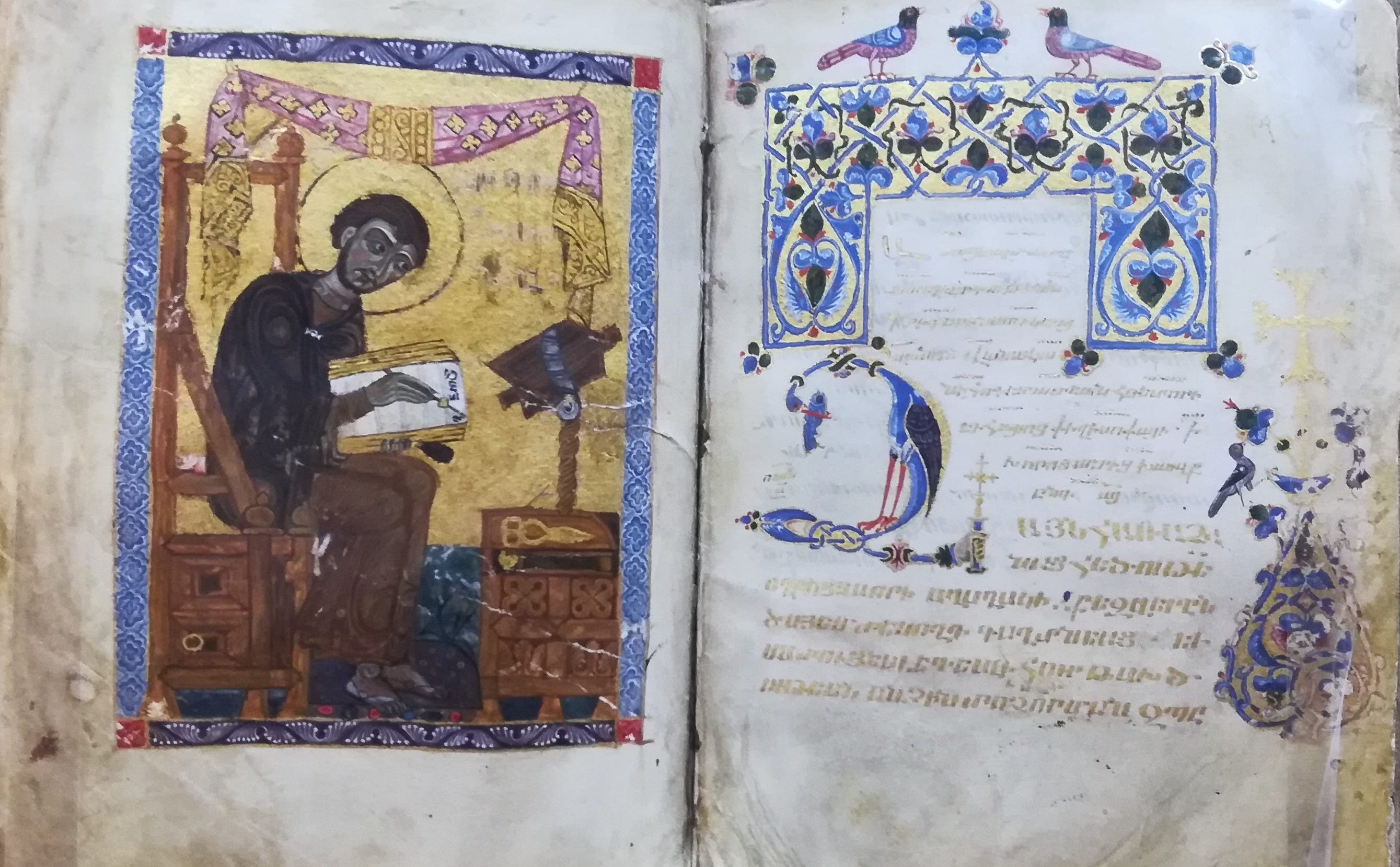
There are eighteen major Rites in the Catholic Church, with eighteen different ways to celebrate the Holy Sacrifice of the Mass, of which the Latin Rite is one. We should keep in mind that the Mass is essentially one and the same Apostolic Liturgy in all valid Rites. Aramaic was the common language of many Christians in the first four centuries of the Catholic Church. Syriac was one dialect of Aramaic and was used especially in the ancient Christian city of Edessa, at the same location on the Daysan River as the modern city of Urfa in Turkey. Edessa became a major Christian center of Greek and Syriac theological and philosophical thought but fell under Arab control in the middle of the seventh century. From Edessa, the Christian evangelization of Armenia in the third century was very successful, and Armenia became the first Christian nation in 301. The Armenian alphabet was then invented at Edessa at the beginning of the fifth century.
The Catholic Church grew through the language of Syriac and spread all the way to Persia and India, and even to parts of China, as did the ancient syncretistic religion of Manichaeism. In the fourth century the Armenian Rite developed under the influence of the Syriac Rite. The Syriac Christians were very interested in Greek culture and translated much of Greek literature into Syriac. An academic requirement for the study of Greek Patristics to this day is to learn to read Syriac as well as Greek. Syriac remained the language of most Christians in the East until the rise of Islam in the sixth century, when Arabic became the vernacular and Syriac and Armenian Christians fell under Muslim rule. The success of Manichaeism and the opposing rise of Islam in the East led directly to the decline of Syriac Christianity. The early Syriac Rite was geographically much larger than both the Latin and Byzantine Rites.
The Council of Chalcedon in 451 had condemned both the Nestorian and the Monophysite Christological errors. Nestorianism emphasizes the humanity of Jesus to the exclusion of his divinity and posits two distinct persons, one human and the other divine, having separate natures that are united accidently, while Monophysitism emphasizes the divinity of Jesus and maintains that he has only one nature, which is either essentially divine or a synthesis of divine and human attributes. The Confession of Chalcedon provides a very clear statement on the human and the divine natures of Christ, hypostatically united in his divine Person:
We, then, following the holy Fathers, all with one consent, teach people to confess one and the same Son, our Lord Jesus Christ, the same perfect in Godhead and also perfect in manhood, truly God and truly man, of a rational soul and body, consubstantial with the Father according to the Godhead, and consubstantial with us according to the manhood, in all things like unto us, but without sin, begotten before all ages of the Father according to the Godhead, and in these latter days, for us and for our salvation, born of the Virgin Mary, the Mother of God, according to the manhood, one and the same Christ, Son, Lord, only begotten, to be acknowledged in two natures, unconfusedly, unchangeably, indivisibly, inseparably (ἐν δύο φύσεσιν ἀσυγχύτως, ἀτρέπτως, ἀδιαιρέτως, ἀχωρίστως – in duabus naturis inconfuse, immutabiliter, indivise, inseparabiliter), the distinction of natures being by no means taken away by the union, but rather the properties of each nature being preserved, and concurring in one Person (prosopon) and one Subsistence (hypostasis), not parted or divided into two persons, but one and the same Son and only begotten God (μονογενῆ Θεόν), the Word, the Lord Jesus Christ, as the prophets from the beginning [have declared] concerning him, and the Lord Jesus Christ himself has taught us, and the Creed of the holy Fathers has handed down to us.
Armenian Christians have always had various conflicting and shifting loyalties to the ancient Christologies that include Monophysitism, Chalcedonianism, and Miaphysitism, with the latter proposing that Christ is both fully divine and fully human in one essentially composite nature. The Armenian Church is independent and autocephalous, tracing its origins to the missionary endeavors of the Apostles Thaddaeus and Bartholomew, but its bishops were originally under the Patriarch of Antioch and the See of Caesarea in Cappadocia. The Armenian monk and theologian St Gregory of Narek (950-1003) was involved in the founding and development of the Monastery of Narek (Narekavank) on the shores of Lake Van when Armenia was an independent kingdom after being liberated from Muslim rule. He was the abbot there, and he and his monks were sympathetic to Chalcedonianism.
In the eleventh century, openness towards Rome began. The Catholicos [Principal Bishop] Gregory II made a pilgrimage to Rome to honour the relics of the apostles Peter and Paul, and in the subsequent years the various Catholicoi acknowledged the Pontiff as Peter’s Successor. From 1205, a number of Catholicos received the pallium in Rome. In the fourteenth century Franciscan and Dominican missionaries arrived in Armenia and established religious centres, but problems with the local hierarchies led to a fracture in 1441, the year in which the Armenian hierarchy split into two branches, Sis and Etchmiadzin. In the eighteenth century there was a religious and cultural reawakening thanks to the priest Mekhit’ar who, after converting to Catholicism, founded a congregation in Constantinople but was persecuted and sought refuge in the island of St. Lazarus in Venice. In 1740 a synod of Armenian bishops gathered in Rome to elect the first Catholic patriarch of Armenian rite, established provisionally in Kraim, Lebanon; in 1742 a new seat of the Armenian Catholic patriarchate was instituted in Bzommar, Lebanon. It transferred to Constantinople in 1866 but returned to Bzommar in 1925, where it remains to this day. (Holy See Press Office, N. 160623b, 2016-06-23, “A Brief History of the Church in Armenia,” https://press.vatican.va/content/salastampa/en/bollettino/pubblico/2016/06/23/160623b.pdf)
During World War I from 1915 to 1917 about one million Armenian Christians were targeted and exterminated by the Ottomans in Turkey, which is regarded as the first major holocaust of the 20th century (the actual number of deaths is disputable, but the fact of the deportation and violence is undeniable). Many other such holocausts were to follow. Adolf Hitler, for example, imitated the pattern of extermination and used it against millions of Jews in Europe, calling it “The Armenian Solution.” The Monastery of Narek was abandoned in 1915 and demolished around 1951. A mosque now stands on its location. Veneration of St Gregory of Narek has never waned, and his writings were recommended to the Universal Church by Pope St John Paul II, who signed a joint declaration with His Holiness the Catholicos of All the Armenians, Karekin II, affirming that the Armenian Church and the Roman Catholic Church have a common origin. St Gregory of Narek was then declared the 36th Doctor of the Church by Pope Francis in 2015.
As a holy theologian St Gregory of Narek composed powerful intercessory prayers in his Book of Lamentations and was influenced by St Gregory of Nyssa and the apophatic tradition. Like many other apophatic theologians of the East and the West, he wrote a commentary on The Song of Songs or The Blessing of Blessings, as he called it. In Christian theology, there are two fundamental and complementary ways to grasp something of the mystery of God—the positive way and the negative way—which are then reconciled in the analogical way of eminence and transcendence. Positive theology proceeds by way of the dogmatic affirmations which can made about God, while negative theology proceeds by way of the difference between God and created beings and emphasizes the ineffable knowledge that existential union with Christ by faith, hope, and love brings to the human heart. These two ways are complementary and should be integrated. The abstract language of dogma and the mystical language of poetry are both valid means of knowing God and should not be set in false opposition. In the ascent of our minds and hearts to the presence of God in our souls by nature and grace, the positive and negative modes of theology work together to help us to grow in holiness and to receive an even higher knowledge of God through the transformation of our capacity to participate in his divine Wisdom and Love. This higher mystical knowledge is attained only when God reveals his divine Presence to us in our souls.
The purpose of Christian prayer under the effects of grace is to surrender to the difficult but delightful spiritual transformation of the mode of the receiver. Corresponding to the positive and negative modes of theology are the two fundamental modes of prayer: the kataphatic way and the apophatic way. Both are essential to the transforming union of the soul with God. Kataphatic prayer is active and proceeds by way of images, concepts, words, devotions, creation, truth, goodness, beauty, and discursive reason. Apophatic prayer proceeds simply by way of the divine love and that God infuses in our souls through Christ and the Holy Spirit. The integrated practice of the active and passive modes of prayer in union with Christ ordinarily gives rise to mystical prayer, which is fully contemplative and directly infused by God. The ultimate goal of Christian prayer is a continuous loving trinitarian communion with God in Christ through the Holy Spirit. A transformation of the heart is required because in the conditions of sin and attachment to sensible goods we do not naturally or easily attend to God in loving communion with his Presence in the soul. The transformation of the heart is possible only by personal effort and the help of grace. The spiritual life of prayer is therefore a battle, for we must struggle against ourselves, the world, and demons. Spiritual marriage between Christ and the soul is the Biblical and analogical representation of the struggle to overcome temptations and vices, to acquire self-mastery and virtues, and to remain faithful and attentive to God and his inspirations. This is the supernatural goal of every true disciple of Christ. Ultimately it is Christ who makes this goal attainable, and he offers his help to everyone who sincerely seeks God above all things in every state and walk of life.
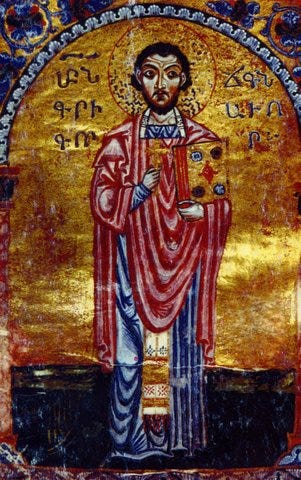
St Gregory of Narek is a reliable spiritual guide who uses the Biblical language of analogy and allegory to write beautifully and poetically about the existential apophatic dialogue and communion of love between Christ and the soul.
Blessed are they who are worthy of the unfading crown and are wedded to Christ, for they will share His crown in the endless kingdom of Christ.
“How beautiful and delightful you have become; love to your delicacy![sic]” [the Bridegroom says to the Bride in The Blessing of Blessings.] Look precisely at the praises listed for all the Bride’s senses; see how, having listed them one by one and praised them, [Christ the Bridegroom] summarizes them again, by saying how beautiful and delightful you have become. The real beauty of a human being is to cause all one’s senses to serve God, and to divinize them by drawing near to God, by participating in the divine works, in order to become worthy of hearing such words from Christ the Bridegroom: “You have become beautiful and delightful to me.”
What immeasurable bliss! By the mouth of God to be professed beautiful and delightful to Him whom all the saints, apostles and prophets desired, the martyrs and ascetics, and the vardapets [teachers] of the Church with all her clergy. Becoming the Daughter and Bride of God, they forgot their people and their fathers’ house (Ps 44:11); becoming strangers to the world and whatever is in this world, they became delightful through their virtuous ways of life, and were loved by the Groom, who said, “Love to your delicacy!”; that is, “I love your great delicacy just as bodily bridegrooms love their physically delicate brides.” (The Blessing of Blessings: Gregory of Narek’s Commentary on the Song of Songs, translated with an introduction and notes by Roberta R. Ervine, Cistercian Publications, 2007, p. 181)
St Gregory of Narek also clearly explains that the foundation of this spiritual communion of the soul with Christ is Eucharistic Communion and the imitation of the Blessed Virgin Mary.
By what was the Bride empowered to be a fellow traveler on Christ’s way? By the awesome mystery of Communion—by the body and the blood of Christ which He gave to us for strength.
“He made us bold to drink with our lips and break with our teeth that on which you the angels, you sisters and queens, did not dare to gaze; we were allowed to break with our teeth Him of whom no bone was broken on the Cross, as the Prophet had predicted aforetime (Ps 33:21). In our earthly incinerated flesh we are not consumed by the uncontainable and flaming Fire, whereas you angels are not able to look upon it—nor do you dare to. I have become the container for the Uncontainable, like the Theotokos, who received Him into Her womb and was not burned, and like her archetype the burning bush.” Thus does the Bride boast before the angels; as it were, boasting in the unspeakable gift of the Groom. Going on she adds, “I am my Beloved’s, and His returning is to me.” That is, having been joined to Him through this food, I am His and He is mine. As the Lord Himself said in the Gospel (Jn 6:56), “Whoever eats my body and drinks my blood will live in Me and I in him.” (The Blessing of Blessings, p. 185)
The nuptial mystical theology of St Gregory of Narek is the same Catholic doctrine that we find in the Christian apophatic tradition as a whole. Consider for example the following explanation of the Bridal symbol in nuptial mystical theology of St John of the Cross, which is offered by St Teresa Benedicta of the Cross (Edith Stein):
This image is not an allegory. When the soul is called the Bride of God, there is not only a relationship of similarity between two things which permits one to be designated by the other. There is, much more, such an intimate union between the image and the reality that it is almost impossible to speak of them any longer as a duality. Turned around: the meaning of the expression, being engaged [to be married] has nowhere as fitting and perfect a fulfillment as in the love relationship of God with the soul. That is the hallmark of a symbol-relationship in the strict and actual sense. The relationship of the soul to God as God foresaw it from all eternity as the goal of her creation, simply cannot be more fittingly designated than as a nuptial bond. Once one has grasped that, then the image and the reality directly exchange their roles: the divine bridal relationship is recognized as the original and actual bridal relationship, and all human nuptial relationships appear as imperfect copies of this archetype—just as the Fatherhood of God is the archetype of all fatherhood on earth. By reason of this copy-relationship, the human bridal relationship becomes useful as a symbolic expression of the divine, and in view of this function that which is a purely human relationship in actual life takes second place. Its actual reality has its highest reason for existence in that it can give expression to a divine mystery (Ephesians 5:23 ff). (St Teresa Benedicta of the Cross, OCD, The Science of the Cross, translated by Sr Josephine Koeppel, OCD, ICS Publications, 2002, pp. 242-243)
Through the Sacraments of the Church and the intercessory prayers of St Gregory of Narek, the 36th Doctor of the Church, let us renew our personal efforts daily to surrender unconditionally to the transforming power of grace and thus to enter more completely into mystical dialogue and spiritual communion with Christ.
The Collect for the Memorial of St Gregory of Narek, February 27
Almighty Ever-living God, who were pleased to imbue with mystical doctrine St. Gregory of Narek, the teacher and glory of the Armenian people, grant us by his teaching to learn the art of speaking with you and constantly to fortify our life with the Sacraments of the Church, through our Lord Jesus Christ, your Son, who lives and reigns with you in the unity of the Holy Spirit, God for ever and ever, amen.
About Deacon Tracy Jamison, OCDS, PhD
Deacon Tracy Jamison was raised in a Christian family as the son of a Scotch-Irish evangelical minister in the Campbellite tradition. As an undergraduate he majored in Biblical and Ancient Near Eastern Studies at Cincinnati Christian University, where his parents had been educated. At this institution he met Joyce, who was completing a degree in Church Music, and after graduation they entered the covenant of Christian marriage in 1988. Through the study of philosophy and the writings of the Early Church Fathers, Tracy was received into the full communion of the Catholic Church in 1992. Under the influence of the theological writings of St. John Paul II he began to study the works of St. Teresa of Avila and St. John of the Cross and entered formation as a Secular Carmelite of the Teresian Reform. In 1999 he completed the doctoral program in Philosophy at the University of Cincinnati, and in 2002 he made his definitive profession as a Secular Carmelite. In 2010 he was ordained as a permanent deacon of the Archdiocese of Cincinnati. Currently he is an associate professor of philosophy at Mount St. Mary’s Seminary of the West.
© 2026, Lawain McNeil, Mission Surrender, LLC